Film Review: Brother (Brat, 1997)

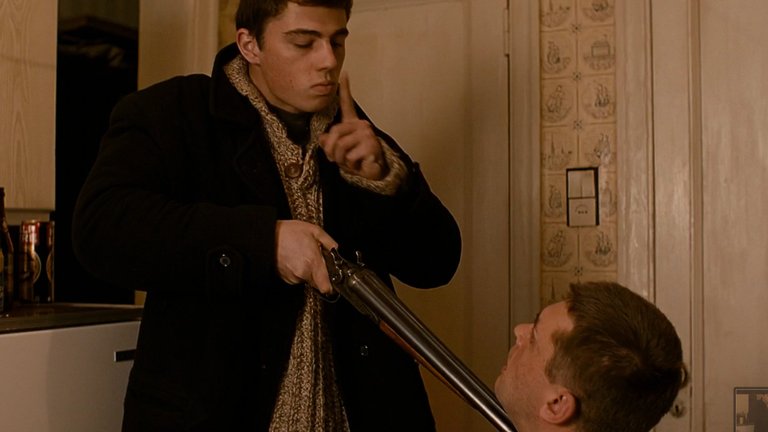
While many in the West look back upon the 1990s with a sense of nostalgia, viewing it as a better, simpler, kinder era marked by progress, peace, and prosperity, in other parts of the world people are profoundly glad that decade is over. Nowhere is this more obvious than in Russia, which endured a period of civil strife, military and political humiliations, economic collapse, and a near‑complete breakdown of law and order. Yet, even such dark and chaotic times can inspire artists in extraordinary ways. One striking example is Alexei Balabanov’s 1997 crime drama Brother. Emerging from the rubble of post‑Soviet Russia, the film not only became one of the most critically acclaimed Russian films of all time but also a major commercial hit, earning a cult status that it retains to this day. Its enduring appeal lies in its unflinching portrayal of a nation in transition, wrapped in the conventions of a gritty gangster thriller.
The film follows Danila Sergeevich Bagrov, played by Sergei Bodrov Jr., a young man freshly discharged from the Russian Army who returns to his provincial hometown. After a drunken episode disrupting a video shoot for the band Nautilus Pompilius, his mother—widow of a career criminal—packs him off to Saint Petersburg, where his older brother Viktor (Viktor Sukhorukov) is said to have made good. Upon arrival, Danila discovers that Viktor is deeply involved in organised crime. To extricate his brother from trouble, Danila is tasked with eliminating a Chechen mobster. He accomplishes the hit with startling efficiency, only to find himself targeted by another gangster, Krugly (Sergei Murzin). What unfolds is a survival story. Danila, though seemingly naïve, proves remarkably resourceful, navigating the harsh streets of the big city with the help of an unlikely ensemble: the homeless street peddler Hoffman (Yuri Kuznetsov), the female tram operator Sveta (Svetlana Pismichenko), with whom he begins a tender romantic relationship, and Kat (Maria Zhukova), a record‑shop clerk who introduces him to the city’s underground music scene, including parties where Nautilus Pompilius themselves perform.
When released abroad, Brother was widely interpreted by Western critics as a veiled sociopolitical commentary on the state of 1990s Russia. Balabanov, who also wrote the screenplay, furnishes ample evidence for this reading. The film captures the brutal transition from Soviet socialism to a raw, predatory capitalism. Residual confusion permeates society: Danila’s mother persistently refers to the former imperial capital as “Leningrad,” and Danila must be informed that locals now call it “Piter.” Danila himself embodies this cultural schism. On one hand, he enthusiastically embraces Western‑influenced rock music and technology—a CD player, notably, becomes a literal lifesaver in one scene. On the other, at a party filled with foreigners, he expresses disdain for techno music and bluntly wishes collapse to America. The film does not shy away from the ethnic tensions that flared in the post‑Soviet vacuum. Danila casually hurls racial abuse at Caucasians and, upon learning Hoffman is ethnic German, declares that he “prefers Germans to Jews.” This unvarnished dialogue led some foreign commentators to accuse Brother of racism and anti‑Semitism. Yet, to dismiss the film on these grounds is to overlook Balabanov’s method: he holds up a mirror to the prejudices and tribal loyalties that flourished in the moral vacuum of the time, without necessarily endorsing them. The film’s power derives from its refusal to sanitise its protagonist or his world.
Politics aside, Brother functions superbly as a gangster film. Balabanov clearly draws inspiration from genre classics, most notably Mike Hodges’ Get Carter. Like Carter, Danila is an outsider who arrives in a city to confront the gangsters who have entangled his brother. This influence is felt in the film’s taut, revenge‑driven narrative and its bleak outlook. The choice of weaponry further underscores this lineage: Danila’s procurement of a shotgun for the final showdown echoes the visceral, close‑quarter violence of hard‑boiled crime cinema. Balabanov’s direction is assured and economical. He allows the plot to unfold with a brisk, comprehensible pace, using fades to black to punctuate key scenes—a simple but effective stylistic touch that lends the film a rhythmic, almost episodic quality. His utilisation of Saint Petersburg locations is equally astute. Rather than the city’s picturesque canals and palaces, Balabanov presents its grimy courtyards, bleak housing blocks, and rain‑slicked streets, crafting an atmosphere of pervasive gloom. So iconic are these settings that, years later, location tours were organised for dedicated fans.
Adding immense local flavour is the film’s soundtrack, populated by Russian rock bands and musicians, many of whom Balabanov had previously collaborated with on music videos. Groups like Nautilus Pompilius not only provide the film’s driving musical backdrop but also appear in cameo roles as themselves. This clever integration served a practical purpose: it allowed producer Sergei Selyanov to complete the film on an extremely low budget. The music does more than save money; it roots the film firmly in its moment, capturing the anarchic energy of the Russian rock scene that thrived amidst the chaos.
The film’s greatest asset, however, is Sergei Bodrov Jr. in the role of Danila. Bodrov plays the enigmatic protagonist with a compelling, understated charisma, embodying the old‑school “strong silent type” reminiscent of Charles Bronson. With his striking looks—which might recall Alain Delon to older viewers and Liam Hemsworth to younger ones—Bodrov unashamedly leverages his screen presence, yet never slips into mere vanity. His Danila is a killer with a childlike directness, capable of brutal violence and unexpected tenderness. It is a performance of remarkable subtlety, and it turned Bodrov into a matinee idol across Russia, a symbol of a certain rugged, resilient masculinity that resonated deeply with a disoriented public.
The success of Brother inevitably led to a sequel, Brother 2 (2000), which transplanted Danila’s exploits to the United States and gained even greater international recognition. The tragic death of Sergei Bodrov Jr. in 2002, during a landslide while filming Balabanov’s unfinished project The Messenger, cemented the film’s iconic status. Both Brother and its sequel became embedded in Russian popular culture, referenced endlessly in music, television, and everyday discourse. In 2024, a controversial and unauthorised sequel, Brother 3, emerged, failing predictably to recapture the original’s raw power or cultural relevance—a testament to how deeply the first film is tied to its specific historical moment and its irreplaceable star.
Alexei Balabanov’s Brother is a landmark of Russian cinema. It is a film that captures the despair, violence, and moral ambiguity of the 1990s with unflinching clarity, while simultaneously delivering a gripping, expertly crafted gangster narrative. Its controversial elements are integral to its authenticity; this is not a comfortable film, but it is an essential one. Bolstered by Bodrov’s star‑making performance and Balabanov’s keen direction, Brother remains a powerful, unsettling, and enduring document of a nation in turmoil.
RATING: 8/10 (+++)
==
Blog in Croatian https://draxblog.com
Blog in English https://draxreview.wordpress.com/
InLeo blog https://inleo.io/@drax.leo
InLeo: https://inleo.io/signup?referral=drax.leo
Leodex: https://leodex.io/?ref=drax
Hiveonboard: https://hiveonboard.com?ref=drax
Rising Star game: https://www.risingstargame.com?referrer=drax
1Inch: https://1inch.exchange/#/r/0x83823d8CCB74F828148258BB4457642124b1328e
BTC donations: 1EWxiMiP6iiG9rger3NuUSd6HByaxQWafG
ETH donations: 0xB305F144323b99e6f8b1d66f5D7DE78B498C32A7
BCH donations: qpvxw0jax79lhmvlgcldkzpqanf03r9cjv8y6gtmk9