Film Review: Infernal Affairs II (2003)

The 2002 Hong Kong crime thriller Infernal Affairs is perhaps best known to Western audiences as the basis for Martin Scorsese’s 2006 Hollywood remake The Departed, the film that finally brought the esteemed director his long-sought Oscar. Yet, for aficionados of the genre, the original is not only, for obvious reasons, more original but also, for not so obvious reasons, a slightly superior film—tighter, faster, and more compelling in its storytelling. It was also a monumental box office hit across domestic and Asian markets, a success that producers were quick to exploit with two sequels launched in rapid succession. The first of these, Infernal Affairs II (2003), is a fascinating if flawed endeavour that expands the saga’s universe while stumbling under the weight of its own ambitions.
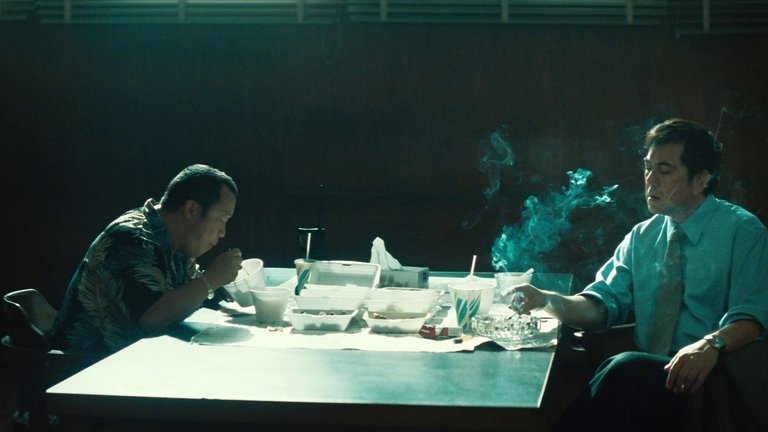
Once again directed by the duo of Andrew Lau and Alan Mak, with a script by Mak and Felix Chong, the film is a prequel, dialling the clock back to 1991, more than a decade before the events of the original.^1^ This allows the formidable Anthony Wong and Eric Tsang to reprise their roles as police inspector Wong and triad member Hon Sam, respectively. Here, their relationship is shown in its infancy: outwardly courteous, with Wong attempting to recruit Sam as an informant within the criminal underworld. Concurrently, both men are grooming the youths who will become the moles at the heart of the first film’s conflict—Lau Kin-ming (played by a young Edison Chen) is Sam’s protégé destined to infiltrate the police, while Chan Wing-yan (Shawn Yue) leaves the police academy to embed himself within the triads under Wong’s direction.
The plot is set in motion by the assassination of Ngai Kwun (Joe Cheung), the patriarch of a powerful crime family. His underlings subsequently withhold tribute from his son and successor, Wing-hau (Francis Ng), who also happens to be Yan’s half-brother. What unfolds is a complex tapestry of power struggles, betrayals, and revenge spanning years. It is eventually revealed that Sam’s ambitious wife, Mary (Carina Lau), orchestrated Kwun’s murder to advance her husband’s standing, even attempting to enlist Inspector Wong in her scheme. Her subsequent murder and Sam’s eventual return to Hong Kong on the eve of the 1997 handover to testify against Hau culminate in a confrontation where Wong shoots Hau to save Sam’s life, irrevocably cementing their future rivalry.
Notably, Tony Leung and Andy Lau, the iconic leads of the first film, do not appear, their younger counterparts taking centre stage. Their characters are largely peripheral here, which, given the narrative’s focus, does not significantly detract from the film. Instead, the script shrewdly shifts its attention to the deepening conflict between Sam and Inspector Wong. It is a pleasure to watch Eric Tsang and Anthony Wong, two veterans at the peak of their powers, chart the evolution of a relationship that begins with a veneer of mutual respect and deteriorates into bitter enmity. The supporting cast is equally compelling: Carina Lau is superb as the manipulative, Lady Macbeth-like Mary, whose machinations trigger the cycle of violence, while Francis Ng delivers a nuanced performance as Hau, transforming from a son with legitimate aspirations into a ruthlessly efficient gangster who is nevertheless outmanoeuvred.
Where the film proves particularly interesting is in its use of the 1997 British handover of Hong Kong as a persistent backdrop. This historical pivot is not mere set dressing; it effectively symbolises the seismic shifts within the territory’s institutions, showing how the weakening of one regime before the establishment of another creates a volatile environment where policemen like Wong take their war against the triads personally. The uncertainty of the era mirrors the moral ambiguities and shifting loyalties of the characters, adding a layer of political resonance often absent from standard genre fare.
However, Infernal Affairs II is not without its significant shortcomings. The film suffers from a slow, deliberate tempo and a slightly confusing opening act that demands prior knowledge of the original to navigate its labyrinthine plots. More egregiously, it is marred by a curiously poor choice of music. The directors’ occasional lapse into what some have termed “Godfather pretensions” is exemplified by the use of Hungarian chorals, which feel profoundly out of place. This scoring decision renders an otherwise gritty, no-nonsense gangster drama momentarily pretentious and artsy, undermining the tension and realism the film works hard to establish.
Infernal Affairs II is a prequel that exists primarily because of the phenomenal success of its predecessor. It expands the mythology with intelligence and features powerhouse performances from its central duo. Yet, it is ultimately a slower, more convoluted, and at times tonally inconsistent film that lacks the propulsive, sleek thrill of the original. Despite these flaws, anyone who appreciated the intricate cat-and-mouse game of Infernal Affairs or the brutal dynamics of The Departed will likely find much to enjoy in this ambitious, if imperfect, chapter of Hong Kong cinema’s most celebrated crime saga.
RATING: 6/10 (++)
==
Blog in Croatian https://draxblog.com
Blog in English https://draxreview.wordpress.com/
InLeo blog https://inleo.io/@drax.leo
InLeo: https://inleo.io/signup?referral=drax.leo
Leodex: https://leodex.io/?ref=drax
Hiveonboard: https://hiveonboard.com?ref=drax
Rising Star game: https://www.risingstargame.com?referrer=drax
1Inch: https://1inch.exchange/#/r/0x83823d8CCB74F828148258BB4457642124b1328e
BTC donations: 1EWxiMiP6iiG9rger3NuUSd6HByaxQWafG
ETH donations: 0xB305F144323b99e6f8b1d66f5D7DE78B498C32A7
BCH donations: qpvxw0jax79lhmvlgcldkzpqanf03r9cjv8y6gtmk9