Television Review: A Night to Remember (Mad Men, S2x08, 2008)

A Night to Remember (S2x08)
Airdate: 14 September 2008
Written by: Robin Veith & Matthew Weiner
Directed by: Leslie Glinka Glatter
Running Time: 48 minutes
One of the perennial challenges for a television series of Mad Men’s calibre is the inevitable narrative ebb and flow; a towering, brilliant episode often casts a long shadow over its immediate successor, making a merely competent instalment appear wan and uninspired by comparison. This dynamic is starkly evident in the second season’s sequencing. The narrative and thematic brilliance of The Gold Violin (S2E07), an episode that masterfully deconstructed the American Dream through the purchase of a Cadillac and the devastating Stork Club confrontation, is followed by the decidedly pedestrian affair of A Night to Remember (S2E08). Despite the show’s unwavering technical polish—the impeccable period design, the subtle cinematography, the restrained acting—this episode cannot shake the aura of uninspired filler, a necessary but clumsily executed piece of plot machinery designed to formalise a marital rupture that the previous episode had already devastatingly implied.
The episode’s title, ‘A Night to Remember’, deliberately evokes Walter Lord’s seminal 1955 book on the sinking of the RMS Titanic, for decades the definitive account of that disaster. Here, the disaster is domestic. The metaphorical iceberg was struck in ‘The Gold Violin’, when Jimmy Barrett’s vicious revelation at the Stork Club left Betty Draper humiliated and physically sickened. In this episode, what begins to sink is the Draper’s previously picture-perfect marriage.
The psychological toll of that night is the episode’s central, albeit unevenly handled, concern. Betty, portrayed with brittle precision by January Jones, initially attempts to maintain the facade of the impeccable suburban housewife. She goes through the motions, even seeking release through horse riding—a classic symbol of repressed passion and frustration. Yet, the facade cannot hold. The cracks appear in a series of telling, unconscious lapses: she accidentally destroys a side table, and later, in a moment of distracted carelessness, injures her foot. These are subtle, effective touches that show a mind and spirit coming undone under the strain of knowledge she cannot yet openly acknowledge. She is a vase developing hairline fractures before the final shatter.
The shattering force is the ill-fated dinner party. In a bid to impress Roger Sterling, Duck Phillips, and the acquintance Crab Colson and his wife Petra (Amy Landecker), Betty plans an elaborate ‘around the world’ menu. The centrepiece, Heineken beer, becomes the instrument of her humiliation. She learns, to her horror, that Heineken is the subject of Sterling Cooper’s new campaign and that Don had manipulated her into featuring it. This public revelation—that her domestic sphere has been co-opted by her husband’s professional deceit—is the final insult. The evening is a great example of a quiet agony, with Betty’s smile growing ever more strained. Afterwards, she confronts Don about his affair with Bobbie Barrett. Jon Hamm plays Don’s denial with practised, weary defiance, but Betty is now adamant. Her frantic, almost pathetic search for evidence—rummaging through his desk and clothes—yields nothing tangible, yet her conviction is absolute. The next day, she delivers the coup de grâce in a chillingly calm phone call to his office: “Don’t come home.” The image of Don, the master of appearances, reduced to spending the night in his office with a bottle of Heineken as his sole comfort, is a potent irony. The product he sold has become the symbol of his exile.
Unfortunately, the compelling gravity of the Draper’s collapse is diluted by two undercooked and largely inconsequential subplots. At Sterling Cooper, Harry Crane, the perpetually overwhelmed head of television, is chastised by Duck Phillips for a disastrous ad placement for Maytag, washing machine manufacturer. The ad aired during a drama about Communist agitators, risking the association of Maytag with May Day. Harry’s plea of being overworked leads to Joan Holloway being temporarily assigned to assist him. Christina Hendricks brings her usual commanding presence to scenes where Joan efficiently manages the crisis, highlighting the show’s recurring theme of capable women propping up incompetent men. Yet, this promising thread is abruptly severed when Roger hires a man, Daniel Lindstrom (Jonathan Runyon), for the role. Joan’s disappointment is palpable but unexplored. This storyline is told from Harry’s perspective, but its true protagonist is Joan, who once again performs essential labour only to be sidelined when a man is available. The opportunity to deepen this through the context of her engagement to Greg Harris (Sam Wise) is missed, rendering it a frustrating narrative cul-de-sac.
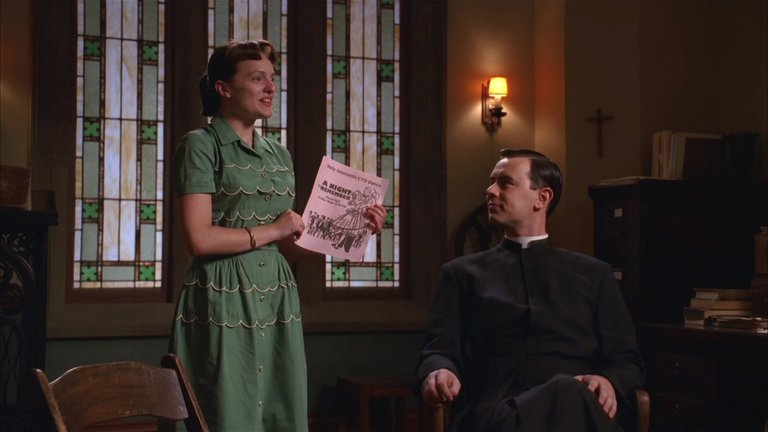
Similarly, the continuation of Peggy Olson’s interactions with Father Gill feels like wheel-spinning. The young priest again seeks her professional help, this time for posters promoting a church dance. Peggy delivers copy with the slogan “A Night to Remember,” which Father Gill approves, only for old parish committee women to reject it, forcing a revision. The scenes are well-acted by Elisabeth Moss and Colin Hanks, but they reveal nothing new about Peggy’s complex relationship with faith, career, and her secret pregnancy. They function as filler, a lightweight counterpoint to the Draper heaviness that fails to resonate. The subplot’s sole interesting beat is its coda: after a montage of characters retiring for the night, we see Father Gill, stripped of his clerical collar and in casual clothes, strumming a folk song on a guitar. It’s a brief, evocative glimpse of the burgeoning folk music trend and a reminder of the personal identities hidden beneath societal roles—a theme the episode elsewhere handles with less finesse.
Written by Matthew Weiner and Robin Veith, A Night to Remember is, in essence, a solid episode of television that fails spectacularly to live up to its potential. Its core function is to deliver the ‘wham’ event of Betty finally voicing her knowledge and ejecting Don—a necessary narrative pivot. However, it executes this pivot in an unremarkable, almost anticlimactic manner. The dinner party, while tense, lacks the raw, visceral power of the Stork Club confrontation; the final phone call feels like a foregone conclusion rather than a dramatic peak. The episode’s crucial flaw is its lack of focus. The Draper disaster, a seismic event for the series, shares space with two minor subplots that are neither properly integrated nor meaningfully explored.
This lack of focus extends to a missed meta-textual layer. The episode was reportedly the source of off-camera controversy due to the inclusion of Heineken. It was not a creative decision but the result of a sponsorship deal between Heineken and AMC, a cost-cutting measure insisted upon against Matthew Weiner’s wishes. This behind-the-scenes reality adds a layer of unintended irony to the narrative: the very product that betrays Betty in her home is itself an intrusion of corporate compromise into the artistic fabric of the show. The advert has literally invaded the drama.
In the end, A Night to Remember is the narrative equivalent of tidying up after a brilliant party. The real event—the catastrophic humiliation, the shattered illusions—happened the night before. This episode is necessary housekeeping, executed with professional skill, but it lacks the inspiration, thematic depth, and dramatic force that define Mad Men at its best.
RATING: 6/10 (++)
==
Blog in Croatian https://draxblog.com
Blog in English https://draxreview.wordpress.com/
InLeo blog https://inleo.io/@drax.leo
LeoDex: https://leodex.io/?ref=drax
InLeo: https://inleo.io/signup?referral=drax.leo
Hiveonboard: https://hiveonboard.com?ref=drax
Rising Star game: https://www.risingstargame.com?referrer=drax
1Inch: https://1inch.exchange/#/r/0x83823d8CCB74F828148258BB4457642124b1328e
BTC donations: 1EWxiMiP6iiG9rger3NuUSd6HByaxQWafG
ETH donations: 0xB305F144323b99e6f8b1d66f5D7DE78B498C32A7
BCH donations: qpvxw0jax79lhmvlgcldkzpqanf03r9cjv8y6gtmk9