Television Review: Babel (Star Trek: Deep Space Nine, S1x05, 1993)

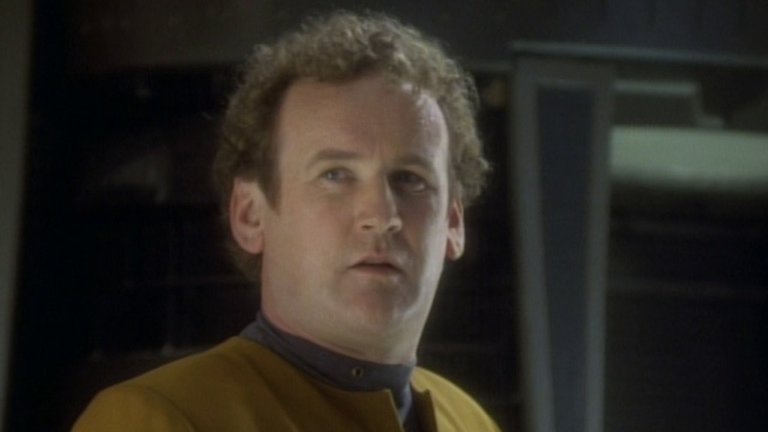
Babel (S01E05)
Airdate: 24 January 1993
Written by: Michael McGreavy & Naren Shankar
Directed by: Paul Lynch
Running Time: 46 minutes
From its very inception, Star Trek: Deep Space Nine set itself apart from its predecessors by embracing a distinctly darker, more morally ambiguous tone. It traded the Enterprise’s hopeful exploration for the grim reality of a war-torn, politically fractious frontier outpost. A prime and early example of this deliberate tonal shift is the fifth episode of the first season, Babel. Its premise is, upon reflection, quite terrifying—a creeping, silent disease that dismantles the very fabric of society—and is rendered all the more unsettling because it is rooted in a real-world medical condition. The episode’s genius, and its ultimate failure, lies in how this horrifying concept is initially presented through a lens of the mundane and even the faintly comical, a disarming tactic that the script never fully capitalises upon.
The episode begins in a deceptively mundane tone, perfectly capturing the station’s central metaphor as a decaying, bureaucratic nightmare. Chief Miles O’Brien, the everyman engineer, is visibly frustrated with the Sisyphean task of maintaining the Cardassian-built station. His life is a litany of constant repairs, particularly of the malfunctioning replicators left behind by the former occupiers. It is during one such routine repair that he accidentally triggers a hidden device,. This is the episode’s first masterstroke: embedding a planet-killing weapon within the banal headache of faulty plumbing. At first, the consequences seem minor. O’Brien merely acts more exhausted and irritable than usual. Then, with chilling suddenness, he begins to talk in gibberish. He is swiftly diagnosed with aphasia, a condition where the brain’s language centres are compromised, severing a person’s ability to communicate with the outside world. When Lieutenant Dax begins exhibiting the same symptoms, Dr. Bashir realises this is an infection. Captain Sisko’s order for a quarantine comes too late; the silent plague begins its inexorable spread through the population.
The investigation that follows reveals the virus’s insidious mechanism. It infiltrated the station’s replicators, which the entrepreneurial Quark had been illicitly rerouting to supply his bar. Initially spread through contaminated food, the pathogen mutated, becoming airborne and untraceable. Dr. Bashir discovers the virus is an artificial creation, a sleeper weapon planted during the Cardassian occupation. As the command staff, including Sisko, succumbs to the gibbering silence, the burden falls to Major Kira. In a race against time, she identifies the creator: a Bajoran scientist named Sumrak Ren (Matthew Falson), a former resistance fighter. After he refuses to help from the safety of Bajor, Kira has him beamed directly to the infected station. Once infected himself, his self-preservation instinct overrides his principles, and he is forced to develop an antidote.
Parallel to this central crisis, the episode offers its most successful element: the burgeoning ‘frenemy’ dynamic between Quark and Odo. With the station in chaos, a Boslic freighter captain, Jaheel (Jack Kehler), attempts to breach the quarantine to save his spoiled cargo. His damaged ship, still docked, threatens to explode and take the station with it. Quark, revealed to be immune, and Constable Odo, whose shapeshifting biology makes him invulnerable, are forced into an uneasy alliance. Their efforts to jettison the freighter, which succeeds in a safely distant explosion, provide the episode’s only genuine pulse of tension and heroism. It is a compelling subplot that saves the narrative from becoming a static medical mystery, showcasing the series’ unique potential in pairing its most ideologically opposed characters.
The script, co-written by television veteran Michael McGreavy and Star Trek’s unofficial science advisor Naren Shankar, is built upon an intellectually intriguing premise. The concept of aphasia as a vehicle for societal breakdown is potent, illustrating how the collapse of language unravels professional, familial, and communal bonds, leading to a near-apocalyptic scenario. Yet, the pervasive sense of doom is fundamentally tempered by the audience’s conditioned expectation. Much like the recurring ‘Enterprise will explode’ plots of earlier Trek, there is an inherent safety net; viewers know that by the episode’s end, the status quo will be restored. This inevitability drains the narrative of genuine stakes. The solution itself arrives with an almost deus ex machina convenience—the discovery of the Bajoran scientist and the subsequent development of the cure happen with remarkable speed, and the actual administration of the antidote is relegated to a voiceover narration. The crisis is resolved off-screen, a narrative cheat that feels particularly egregious given the build-up.
This structural weakness is compounded by a more profound script-level disappointment: the decision to make the creator of the bio-weapon a Bajoran resistance fighter rather than a Cardassian oppressor. This is a twist with immense potential, one that could have forced a brutal examination of the ethical quagmire of freedom fighting. What moral line is crossed when a resistance movement contemplates a weapon of apocalyptic devastation against a civilian population, even that of an occupying force? Does the cause justify any means? Babel raises this provocative question only to immediately drop it. Sumrak Ren is less a character than a plot device, his motivations and moral conflict left unexplored. The episode sidesteps the rich, dark complexity it itself introduced, opting instead for a simple, race-against-time thriller resolution.
To a degree, this failing is compensated for by the excellent character work, particularly the scenes between Quark and Odo. Their antagonistic yet weirdly respectful partnership is given room to breathe, and their action-packed subplot allows them to emerge as an unlikely heroic duo. It is a glimpse of the nuanced character dynamics that would later define the series. Furthermore, the direction efficiently sells the creeping horror of the outbreak, with the station’s corridors growing progressively quieter and more chaotic as language fails.
While Babel is a solid piece of television with a memorably terrifying premise, it remains a disappointing and largely forgettable episode. It does not transcend the standard clichés and procedural limitations of 1990s American broadcast television. It introduces profound ideas—the weaponisation of communication, the moral compromises of rebellion, the fragility of society—only to resolve them with a safe, conventional, and intellectually lazy conclusion. It is a fascinating blueprint for what Deep Space Nine could be: darker, more challenging, and willing to stare into the abyss. For this early instalment, however, it merely glances at the abyss before quickly looking away and restoring order with a comforting, and ultimately hollow, voiceover.
RATING: 5/10 (++)
Blog in Croatian https://draxblog.com
Blog in English https://draxreview.wordpress.com/
InLeo blog https://inleo.io/@drax.leo
LeoDex: https://leodex.io/?ref=drax
InLeo: https://inleo.io/signup?referral=drax.leo
Hiveonboard: https://hiveonboard.com?ref=drax
Rising Star game: https://www.risingstargame.com?referrer=drax
1Inch: https://1inch.exchange/#/r/0x83823d8CCB74F828148258BB4457642124b1328e
BTC donations: 1EWxiMiP6iiG9rger3NuUSd6HByaxQWafG
ETH donations: 0xB305F144323b99e6f8b1d66f5D7DE78B498C32A7
BCH donations: qpvxw0jax79lhmvlgcldkzpqanf03r9cjv8y6gtmk9
Hello @yoshitsune
You are losing curation reward when upvoting blackisted, scam accounts because rewards on these accounts tend to be removed.