Television Review: Blackwater (Game of Thrones, S2X09, 2012)

Blackwater (S02E09)
Airdate: 27 May 2012
Written by: George R. R. Martin
Directed by: Neil Marshall
Running Time: 55 minutes
For a series that had, by its second season, already ensnared a vast and varied audience, Game of Thrones was famously parsimonious with its spectacle. Some viewers were genuine aficionados of high fantasy, others were drawn to the intricate web of political melodrama, and a not-insignificant contingent tuned in for the nudity and explicit “spice” that became a hallmark of HBO’s marketing. Yet there existed another category: the battle enthusiasts. I recall a good friend once confessing he watched the show solely for the large-scale engagements, fast-forwarding through all the “boring” scenes in between. For viewers like him, the early seasons could be a test of patience. Key conflicts, such as the pivotal Battle of the Whispering Woods, occurred tantalisingly off-screen. This all changed with Blackwater, the penultimate episode of Season 2. It delivered the series’ first truly spectacular set-piece battle, cementing the tradition of the season’s ninth episode as a guaranteed “wham” moment and fundamentally altering the show’s visual and budgetary calculus.
The event in question is the Battle of the Blackwater, the most decisive engagement of the War of the Five Kings and the narrative climax of George R.R. Martin’s A Clash of Kings. The author himself was entrusted with adapting his own work for the screen, a testament to the episode’s importance. This significance is mirrored in its radical narrative structure: for the first time in the series, the episode abandons its sprawling, multi-continental storytelling to focus entirely on a single location at a single, critical point in time—the defence of King’s Landing. The city stands on the brink of annihilation, besieged by the formidable forces of Stannis Baratheon, who commands a fleet and army that vastly outnumber the defenders. The situation is exacerbated by the garrison’s nominal commander, King Joffrey Baratheon, whose incompetence and cruelty have sapped morale following a string of Lannister defeats at the hands of Robb Stark. As Stannis’s armada approaches, the pretender is supremely confident of victory, though his loyal, pragmatic advisor Ser Davos Seaworth cautions his son Matthos that resistance is inevitable and the price will be high.
Within the city, a palpable sense of doom prevails. Many, including Queen Regent Cersei Lannister, have resigned themselves to defeat. Cersei’s preparation is chillingly practical: she has secured the essence of nightshade to poison herself and her youngest son, Tommen, preferring a clean death to the mass rape and slaughter she believes will follow a city’s fall. Sequestered in Maegor’s Holdfast with the other noblewomen, she drinks heavily and engages in a fascinating, cynical dialogue with Sansa Stark. Here, the episode’s writing shines. While Cersei descends into drunken despair and bitter realism, Sansa—often dismissed as a naïve child—emerges as a pillar of strength. Refusing to succumb to terror, she leads the women in prayer and song, providing a sliver of spiritual solace amidst the horror. This scene is a masterclass in character contrast, with Sophie Turner and Lena Headey delivering career-best performances that win unexpected sympathy for both women.
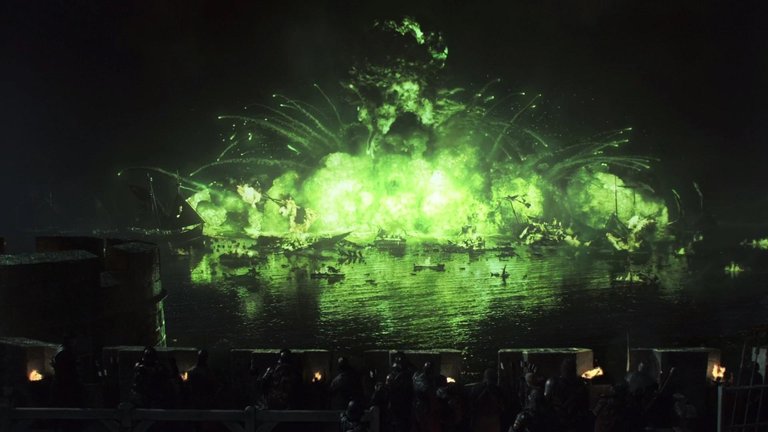
Against this backdrop of despair stands Tyrion Lannister, the acting Hand of the King, who is determined to fight. His ingenious defence plan hinges on a terrifying weapon: wildfire. Eschewing a conventional naval engagement, Tyrion sends a single, unmanned ship leaking the volatile green substance into the heart of Stannis’s fleet. Davos realises the trap too late; Bronn fires a flaming arrow, triggering a cataclysmic explosion that immolates dozens of ships and thousands of men in a blaze of emerald fire. The sequence is a landmark in television visual effects, a shocking, awe-inspiring spectacle that remains visceral over a decade later. The personal cost is immediate, with Davos witnessing the death of his son Matthos in the conflagration.
Despite this devastating blow, the relentlessly stoic Stannis orders the survivors to press the attack in rowboats. The battle shifts to the mud gates, where the numerical advantage still lies with the attackers. It is here that the Hound, Sandor Clegane, suffers a critical breakdown. The sight of men burning alive triggers his deep-seated pyrophobia, rooted in the childhood trauma inflicted by his brother. Overcome, he abandons his post, deserts the king’s service, and in a poignant moment, offers Sansa safe passage north—an offer she wisely declines. His flight creates a leadership vacuum at the precise moment King Joffrey cowardly retreats to the Red Keep, leaving the defenders leaderless.
It falls to Tyrion to rally the remaining troops for a final, desperate gambit: a flanking attack through the city’s underground tunnels. The sortie initially succeeds but devolves into a chaotic melee. In the confusion, Ser Mandon Moore (James Doran) of the Kingsguard attempts to assassinate Tyrion, slashing his face open. Tyrion’s life is saved only by the swift intervention of his squire, Podrick Payne (Daniel Portman). As Tyrion lies bleeding and unconscious, and Cersei prepares to administer the poison to Tommen, the tide turns at the last possible moment. A massive cavalry force, led by Tywin Lannister and Ser Loras Tyrell, crashes into Stannis’s rear. This reveals a last-minute alliance between the two most powerful houses in the realm. A tearful, furious Stannis is physically dragged from the field by his men, and victory is secured for the Lannisters. Tywin’s entrance into the throne room to declare “We have won” is the episode’s final, grim pronouncement.^6^
The production of Blackwater represented a pivotal gamble for HBO. The network’s earlier reluctance to depict large battles was largely budgetary; committing tens of millions of dollars to a single episode was a risk predicated on the show’s established popularity. Even with an increased budget negotiated by showrunners David Benioff and D.B. Weiss, compromises were necessary. The most significant was shifting the battle from daytime in the novels to night. This was a practical decision to mask the limited number of physical ships and ease the integration of CGI, but it came at a narrative cost: the darkness often renders troop movements confusing and obscures tactical clarity.
Nevertheless, the episode compensates through superb writing and acting. The extended, tense build-up—nearly thirty minutes pass before the first clash—is as compelling as the battle itself, masterfully crafting an atmosphere of dread. The character moments are uniformly excellent, particularly the complex Cersei-Sansa dynamic. The episode also serves as the proper introduction of “The Rains of Castamere”, the Lannister anthem hauntingly performed by National over the end credits, cementing its place as one of television’s most iconic musical themes.
Blackwater is unflinchingly violent, featuring some of the series’ most graphic gore to date. It also includes the series’ trademark nudity, notably in a brothel scene with Bronn. Reports suggest director Neil Marshall argued against this full-frontal female nudity as gratuitous, but was overruled by the showrunners. Despite such creative disagreements, Marshall’s work was widely praised, earning him the opportunity to direct another massive battle episode, The Watchers on the Wall, in Season 4.
The episode’s impact was immediate and lasting. It was praised by critics as arguably the best battle sequence ever produced for television”. It won two Creative Arts Emmy Awards for sound and, most prestigiously, the 2013 Hugo Award for Best Dramatic Presentation, Short Form. Blackwater was more than a television event; it was a declaration. It proved Game of Thrones could deliver cinematic-scale warfare on the small screen, setting a new standard for television spectacle and irrevocably raising audience expectations for what was to come. It wasn’t just a battle for King’s Landing; it was the battle that won the war for the soul of the series, proving it could be as much about visceral, large-scale action as it was about whispered intrigues.
RATING: 7/10 (+++)
Blog in Croatian https://draxblog.com
Blog in English https://draxreview.wordpress.com/
InLeo blog https://inleo.io/@drax.leo
LeoDex: https://leodex.io/?ref=drax
InLeo: https://inleo.io/signup?referral=drax.leo
Hiveonboard: https://hiveonboard.com?ref=drax
Rising Star game: https://www.risingstargame.com?referrer=drax
1Inch: https://1inch.exchange/#/r/0x83823d8CCB74F828148258BB4457642124b1328e
BTC donations: 1EWxiMiP6iiG9rger3NuUSd6HByaxQWafG
ETH donations: 0xB305F144323b99e6f8b1d66f5D7DE78B498C32A7
BCH donations: qpvxw0jax79lhmvlgcldkzpqanf03r9cjv8y6gtmk9
Congratulations @drax! You have completed the following achievement on the Hive blockchain And have been rewarded with New badge(s)
You can view your badges on your board and compare yourself to others in the Ranking
If you no longer want to receive notifications, reply to this comment with the word
STOP