Television Review: Breaker of Chains (Game of Thrones, S4x03, 2014)

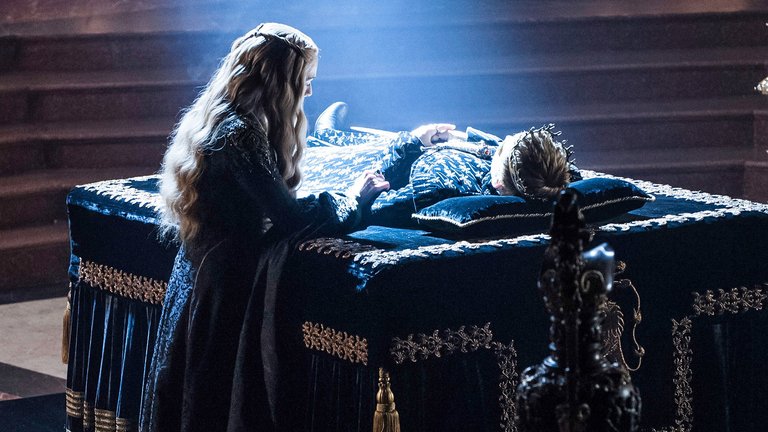
Breaker of Chains (S4x03)
Airdate: 20 April 2014
Written by: David Benioff & D.B. Weiss
Directed by: Alex Graves
Running Time: 56 minutes
Among enthusiasts and scholars of Game of Thrones, few debates inspire such fervent disagreement as the question of precisely when the series "jumped the shark." One of the earliest candidates, and perhaps the most chillingly prophetic, is Breaker of Chains, the third instalment of the fourth series. The reasons for this dubious distinction rest not upon a single scene—a moment of such staggering miscalculation that its reverberations continue to echo through discussions of the series' legacy, foreshadowing the controversial creative decisions that would eventually define its conclusion.
Breaker of Chains arrived in the immediate aftermath of The Lion and the Rose, an instalment that remains among the most universally praised in the series' canon. The Purple Wedding, as it became colloquially known, delivered a therapeutically satisfying dose of karmic retribution as the odious King Joffrey choked and expired before his horrified court. The narrative satisfaction derived from watching pure malevolence receive its just desserts created an atmosphere of near-euphoric goodwill amongst viewers. Consequently, Breaker of Chains bore the unenviable burden of following a masterpiece whilst establishing the dynastic, political, and personal consequences of regicide.
The episode wisely recognises that Joffrey's death, however welcome, precipitates a murder mystery of Byzantine complexity. No true-hearted mourners gather round the late monarch's bier; the boy-king was universally despised, and his obvious death by deliberate poisoning rather than accidental choking transforms virtually the entire court of King's Landing—and indeed significant figures beyond—into credible suspects. The shadowy conspiracy encompasses a deliciously broad spectrum of potential culprits, each bearing plausible motive. Lady Olenna Tyrell sought to protect her granddaughter from a monster; various Lannister rivals harboured long-standing grievances; even covert actors might have orchestrated the assassination for inscrutable purposes of their own. The sole individual beyond suspicion is Cersei Lannister, whose genuine, if smothering, maternal love renders her incapable of wishing harm upon her firstborn. This distinction becomes crucial, for Cersei's grief-fuelled determination to identify and punish the conspirators drives much of the episode's tension.
Amidst this atmosphere of suspicion, even family ties offer no guarantee of innocence. Consider Tywin Lannister, who, whilst his grandson's corpse lies in state, conducts brilliant political education of Joffrey's younger brother and heir, Tommen. Portrayed with understated competence by Dean-Charles Chapman, Tommen receives instruction on the nature of rulership that scarcely conceals Tywin's evident belief that he has inherited an infinitely more suitable candidate—humble, responsible, and responsive where his predecessor was arrogant, impulsive and cruel. Tywin's pragmatism extends to diplomatic overtures delivered with characteristic audacity. Interruption of Prince Oberyn Martell and Ellaria Sand amid an orgy at King's Landing's brothel demonstrates both his disdain for social niceties and his understanding of power. Despite full awareness that Oberyn possesses both motive (the murder of his sister Elia and her children) and expertise (his legendary knowledge of poisons) for involvement in Joffrey's death, Tywin reframes the encounter as opportunity rather than confrontation. The promise of a meeting with Gregor "The Mountain" Clegane offers the vengeful prince a pathway to justice—cleverly positioning their potential alliance against mutual enemies whilst subtly acknowledging the blood-soaked history between their houses.
The contrast with Tywin's actual son could scarcely be more stark. Tyrion languishes in the Black Cells, his position rendered desperate by the mechanics of Westerosi justice. When Podrick Payne visits bearing news, the gravity of his predicament becomes clear: a three-judge panel comprising his own father Tywin, the obsequious Mace Tyrell, and the very Prince Oberyn, will determine his fate. The composition suggests predetermined outcomes, for Cersei's influence ensures that should she possess decisive authority, both Tyrion and Sansa would already hang for crimes they likely did not commit. Cersei's conviction that Sansa participated in conspiracy alongside her husband reflects maternal grief curdled into paranoid fixation—a tragic irony given Sansa's genuine innocence.
That innocence frames one of the episode's more sinister revelations. Following her miraculous escape from the capital, Sansa boards a ship and encounters her unlikely saviour: Lord Petyr Baelish, whose involvement transforms from coincidence to calculation. Littlefinger's manipulation extends years into the past; Ser Dontos Hollard, the pathetic alcoholic knight who "rescued" Sansa during the chaos, proves merely another pawn in his elaborate machinations. Dontos's brutal execution—shot through the face with crossbow bolts—serves dual purposes: eliminating witnesses whilst demonstrating to Sansa and audience alike that Baelish's involvement with the Purple Wedding conspiracy extends far beyond mere opportunism.
The episode's structure maintains the series' characteristic geographical sprawl, adopting an episodic approach to developments beyond the capital. In the Riverlands, Arya Stark witnesses renewed evidence of the Hound's moral degradation as he betrays the hospitality of a struggling farmer, robbing the man who offered shelter during their desperate journey. At Dragonstone, Stannis Baratheon simmers with frustration that Joffrey's death arrived at the precise moment his campaign lacks resources to exploit it—a logistical crisis that inspires Ser Davos Seaworth toward unorthodox financial solutions. The Northern storyline intensifies as Tormund's wildling war-party attacks an innocent settlement, calculated brutality designed to draw Castle Black's garrison into exposed positions. Meanwhile, Samwell Tarly makes a decision of dubious wisdom, dispatching Gilly and her infant son to Mole's Town's dubious protection as a brothel servant, reasoning that her presence amongst the Night's Watch's celibate brothers invites greater danger. Jon Snow argues urgently for preemptive action against the mutineers holding Craster's Keep, understanding that their capture by wildlings would reveal the Watch's numerical weakness—intelligence that could prove fatal in the coming conflict.
The episode's title, however, belongs to Daenerys Targaryen's narrative, which climaxes with her arrival at the slave city of Meereen. The wealthy slavers dispatch their champion, Oznak zo Pahl, portrayed by Daniel Naprous, whose elaborate taunting outside the city walls proves spectacularly ill-advised. Daario Naharis dispatches the braggart with casual efficiency, clearing the stage for Daenerys's theatrical propaganda coup. Addressing Meereen's enslaved population, her catapults fire not destruction but broken chains—symbolic projectiles raining liberty upon the city's battlements. The sequence demonstrates the Mother of Dragons' growing sophistication in combining military might with political theatre.
Written by showrunners David Benioff and D.B. Weiss and directed by Alex Graves, Breaker of Chains demonstrates considerable technical competence. Multiple storylines receive economical yet effective treatment; Graves permits even brief sequences, such as the wildling massacre, to resonate through disciplined visual storytelling. The episode even accommodates playful intertextuality—Oznak zo Pahl's Low Valyrian insults translate directly from the French knight's absurd taunts in Monty Python and the Holy Grail, a knowing wink at genre-savvy audiences.
Yet these accomplishments crumble against the episode's catastrophic centrepiece. When Jaime Lannister enters the Great Sept to find Cersei mourning their son, the scene that follows transforms from complex emotional excavation into something genuinely disturbing. Requesting privacy from the septons and septas, Jaime confronts his twin amidst the sacred space, and what unfolds defies euphemism. The interaction, depicted as non-consensual—despite deriving from a consensual encounter in George R.R. Martin's source material—constitutes sexual assault.
The fan response was immediate and devastating. Viewers who had invested in Jaime's painstaking redemption arc—the gradual transformation from child-murdering villain into honourable, if wounded, protagonist—felt betrayed by this apparently arbitrary regression. Critics decried the depiction as "shock for shock's sake," a cynical attempt to outdo the Purple Wedding's emotional impact through gratuitous brutality. The controversy metastasised through contradictory statements from Martin, Benioff, Weiss, and Graves, whose varying interpretations—ranging from "it becomes consensual" to "it's complicated"—only amplified the perception that the scene had been carelessly conceived.
This single misstep stained the episode indelibly, offering the first genuine taste of Game of Thrones making serious narrative errors—the progenitor of controversial decisions that would eventually culminate in the widely derided series finale. Breaker of Chains, for all its competent plotting and occasional brilliance, thus occupies a peculiar place in television history: a technically proficient instalment remembered primarily for the moment when creative judgment failed catastrophically.
RATING: 6/10 (++)
==
Blog in Croatian https://draxblog.com
Blog in English https://draxreview.wordpress.com/
InLeo blog https://inleo.io/@drax.leo
LeoDex: https://leodex.io/?ref=drax
InLeo: https://inleo.io/signup?referral=drax.leo
Hiveonboard: https://hiveonboard.com?ref=drax
Rising Star game: https://www.risingstargame.com?referrer=drax
1Inch: https://1inch.exchange/#/r/0x83823d8CCB74F828148258BB4457642124b1328e
BTC donations: 1EWxiMiP6iiG9rger3NuUSd6HByaxQWafG
ETH donations: 0xB305F144323b99e6f8b1d66f5D7DE78B498C32A7
BCH donations: qpvxw0jax79lhmvlgcldkzpqanf03r9cjv8y6gtmk9