Television Review: Hardhome (Game of Thrones, S5X08, 2015)

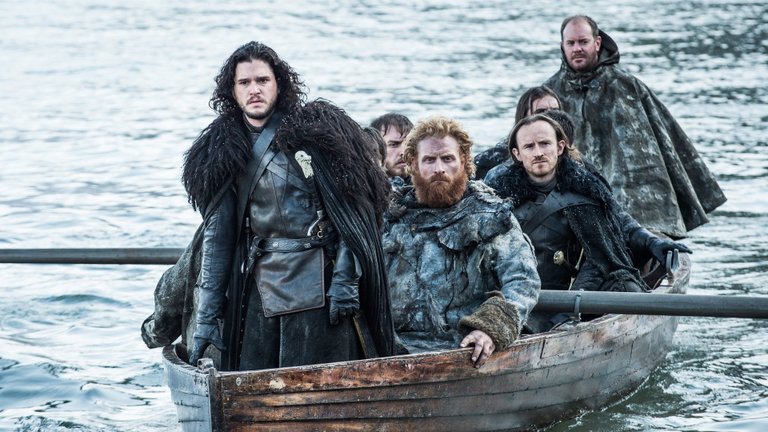
Hardhome (S5x08)
Airdate: 31 May 2015
Written by: David Benioff & D.B. Weiss
Directed by: Miguel Sapochnik
Running Time: 60 minutes
By its midpoint, Game of Thrones had established a formidable tradition: if a truly grand, set-piece battle was to be depicted on screen, it would be saved for the penultimate episode of the season. From the Blackwater in Season 2 to the Watchers on the Wall in Season 4, the structural rhythm conditioned audiences to expect the climactic spectacle one episode before the finale, leaving the last instalment for fallout and narrative realignment. Hardhome, the eighth episode of the fifth season, deliberately strays from this tradition by moving that violent kind of spectacle slightly earlier in the run. This shift is a narrative gambit that fundamentally alters the season's pacing and thematic weight. The episode, written by showrunners David Benioff and D. B. Weiss, further deviates by refusing to let this battle be its sole focus. Instead, the first half is consumed by the usual, often formulaic, moving of various chess pieces across the show's sprawling geographic canvas, a structural choice that creates a jarring, yet ultimately effective, dichotomy.
The episode's opening movements feel like obligatory table-setting. In Meereen, the long-awaited meeting between Tyrion Lannister and Daenerys Targaryen finally occurs. Tyrion, employing his trademark wit and brutal honesty, not only convinces her to spare his life but to take him on as an advisor. In a neat encapsulation of his value, he then advises her to spare Jorah Mormont's life as well, yet still banish him for his past spying and lack of contrition. More significantly, Tyrion offers a sobering assessment of Daenerys's situation, suggesting that consolidating her rule in Slaver's Bay would be an achievement enough and that the Iron Throne might not be worth the immense hassle. Daenerys, however, remains steadfast in her revolutionary confidence, asserting she can transform Westeros just as she ended slavery in Essos. Meanwhile, the banished Jorah, in a grim display of devotion, descends into the fighting pits. This sequence, while rich in dialogue and character, feels like a necessary but perfunctory step in a plotline that has been marking time for much of the season.
Elsewhere, the narrative checks in on other pieces. In Braavos, Arya Stark is given her first assassination mission by the Faceless Men, adopting the identity of a clam-seller named Lanna to reconnoitre her target, the corrupt insurance seller known as the "Thin Man" (Oengus MacNamarra). In King's Landing, Cersei Lannister languishes in a Faith Militant cell, her only visitor the Qyburn, who informs her that her despised uncle Kevan has become the new Hand of the King. Qyburn's suggestion—that a public confession is her only way out—is met with stubborn resistance. In Winterfell, a powerful scene sees Sansa Stark confront Theon Greyjoy, who, amidst his broken state, finally admits his guilt and reveals the vital truth that her brothers Bran and Rickon are alive. This moment of potential catharsis is undercut by the chilling strategy session between Roose and Ramsay Bolton; Roose advocates starving out Stannis's army from within Winterfell's walls, while the psychopathic Ramsay proposes a guerrilla raid to destroy the enemy's supplies. Finally, at the Wall, Samwell Tarly, recovering from his wounds, attempts to tutor the vengeful Olly on the necessity of allying with the wildlings against the greater existential threat of the White Walkers.
These vignettes are competently executed but collectively contribute to a sense of narrative inertia. This is the episode's central tension: it is a tale of two halves, where the first serves primarily to advance storylines, and the second delivers a payoff of such staggering scale that it threatens to eclipse everything that preceded it.
That payoff is, of course, the extended sequence at Hardhome. Jon Snow and Tormund Giantsbane arrive at the large wildling settlement to plead for an alliance. The political negotiations are tense and fragmented, highlighting the deep-seated mistrust on both sides of the Wall. Tormund establishes his authority by brutally killing the mocking Lord of Bones (Ross O’Hennessy), but the council of elders remains divided. The Thenn leader Loboda (Zahary Baharov) is vehemently opposed, while the respected warrior Karsi (Birgitte Hjort Sørensen) and the giant Wun Wun see the logic in Jon's plea. The debate is rendered moot when the Army of the Dead attacks. What follows is not a battle but a horrific slaughter, a relentless onslaught that stands as the most spectacular and terrifying sequence in Season 5, and arguably the entire series to that point.
The production of this sequence was a monumental achievement, particularly given its troubled genesis. Originally planned for Iceland, location losses forced a reconstruction in Northern Ireland, creating significant budget pressures. Director Miguel Sapochnik, who would later helm the acclaimed Battle of the Bastards, managed these constraints masterfully. His direction combines intense, chaotic action with a palpable sense of dread, employing a principle where the most brutal atrocities are often implied rather than explicitly shown. The choreography is visceral, and the prosthetic makeup for the wights creates a genuinely unsettling variety of undead forms, from freshly turned humans to decomposed skeletons. Costume designer Michele Clapton's work subtly delineates the different wildling factions, grounding the chaos in a tangible cultural reality. Crucially, Sapochnik ensures that amidst the spectacle, the fate of characters matters. Performances by Zahary Baharov as the stubborn Loboda and, especially, Birgitte Hjort Sørensen as the resilient Karsi make the audience care about their survival, investing the carnage with genuine emotional stakes.
The sequence is also groundbreaking as the first event of such scale to occur in broad daylight on the show, stripping away the hiding place of darkness and presenting the horror in cold, clear detail. Narratively, it is a huge departure from George R. R. Martin's source material, where the disaster at Hardhome is only mentioned indirectly through dispatches received at the Wall. The decision to depict it directly pays enormous dividends. Within the chaos, key revelations occur: dragonglass can kill White Walkers, but more importantly, Jon Snow discovers that his Valyrian steel sword, Longclaw, is equally lethal. This moment of hope is brutally undercut by the finale. As Jon escapes by boat, he watches the Night King arrive on the shore and raise all the fallen—including the Karsi—as new soldiers in his army. The silent, raised-arm gesture is one of the series' most iconic and chilling images, a stark reminder that every death merely strengthens the enemy.
This concluding moment elevates Hardhome from a great action set-piece to the most unsettling and thematically potent scene of the entire series. It viscerally reminds the audience that the intricate political intrigues, the game of thrones itself, mean nothing compared to the apocalyptic horror gathering in the North. The episode argues that the petty squabbles for power south of the Wall are a dangerous distraction from the existential threat that, if not stopped, will consume all of humanity.
The inevitable critique, however, is that the sheer power of the Hardhome sequence makes the expository dialogues of the first half look pedestrian by comparison. The cutting between Cersei's cell and the frozen shore can feel tonally discordant, almost as if the episode is impatient to get to its main event. Yet, to dismiss this as a flaw is to misunderstand the episode's design. The "banal" political manoeuvring is the very thing the battle renders trivial. The contrast is the point. The episode's structure forces the viewer to sit through the familiar chess moves only to have the board itself violently overturned by a force that does not play by any rules of the game.
Despite this minor structural awkwardness, Hardhome is a very good episode, arguably the season's peak. It arrived at a crucial time, following the controversial and widely criticised Unbowed, Unbent, Unbroken, which featured Sansa Stark's brutal marital rape. "Hardhome" demonstrated that Game of Thrones could still deliver awe-inspiring, narratively significant spectacle even as it strayed further from Martin's source material. It blended technical mastery with profound thematic resonance, delivering a payoff that was both viscerally thrilling and deeply horrifying. The episode restored faith in the show's capacity for grandeur and served as a terrifying promise of the winter that was finally, truly, coming.
RATING: 8/10 (+++)
==
Blog in Croatian https://draxblog.com
Blog in English https://draxreview.wordpress.com/
InLeo blog https://inleo.io/@drax.leo
LeoDex: https://leodex.io/?ref=drax
InLeo: https://inleo.io/signup?referral=drax.leo
Hiveonboard: https://hiveonboard.com?ref=drax
Rising Star game: https://www.risingstargame.com?referrer=drax
1Inch: https://1inch.exchange/#/r/0x83823d8CCB74F828148258BB4457642124b1328e
BTC donations: 1EWxiMiP6iiG9rger3NuUSd6HByaxQWafG
ETH donations: 0xB305F144323b99e6f8b1d66f5D7DE78B498C32A7
BCH donations: qpvxw0jax79lhmvlgcldkzpqanf03r9cjv8y6gtmk9