Television Review: The Climb (Game of Thrones, S3X06, 2013)

The Climb (S03E06)
Airdate: 5 Many 2013
Written by: David Benioff & D. B. Weiss
Directed by: Alik Sakharov
Running Time: 54 minutes
Game of Thrones’ third season established a now-familiar rhythm: a major, eventful episode would be followed by one of deliberate, often sluggish, consolidation. The Climb (S3E6) is a quintessential example of this pattern. Following the emotional and narrative crescendo of Kissed by Fire, this instalment downshifts dramatically, functioning primarily as an exercise in character positioning and thematic exposition. While it advances the plot only incrementally, it compensates with rich dialogue, political intrigue, and one of the series’ most iconic action set-pieces, all bound by a unifying metaphor of struggle and ambition.
The episode’s title operates on two distinct, cleverly linked levels. Most viscerally, it refers to the centrepiece sequence: the gruelling, deadly ascent of the Wall by Jon Snow, Ygritte, and Tormund Giantsbane’s wildlings. Yet, its deeper resonance is found in a monologue delivered a continent away in King’s Landing, where Petyr Baelish unveils his core philosophy to Varys: “Chaos isn’t a pit. Chaos is a ladder.” This duality elegantly connects the physical, survivalist climb in the frozen North with the metaphorical, power-hungry climb in the political South, framing the entire hour as a meditation on the nature of ambition.
Crafted by series creators David Benioff and D.B. Weiss and directed by the esteemed cinematographer Alik Sakharov, the episode is a polished piece of television. Sakharov’s background in photography is evident in the episode’s striking visuals, from the vast, vertiginous shots on the Wall to the intimate, shadow-play of the Red Keep’s chambers. His direction ensures that even talk-heavy scenes crackle with tension.
The literal climb is a masterclass in sustained suspense. Beginning at the Wall’s base, Jon and Ygritte prepare with Tormund, a veteran of such ascents. The sequence is rendered with exhausting authenticity, emphasising the sheer physical danger of scaling 700 feet of ice. Before they begin, Ygritte confronts Jon with a painful truth—she knows his ultimate loyalty remains with the Night’s Watch—but offers a poignant counter-proposal: their loyalty should be to each other above all else. The climb turns catastrophic when an ice collapse triggers an avalanche, killing several wildlings and leaving Jon and Ygritte hanging by a fraying rope. Their survival is a narrow, hard-won victory, and the payoff is one of the series’ most beautiful images: reaching the summit to be greeted by a piercing sun and the first sight of the green Seven Kingdoms sprawling below, a vista that moves the previously hardened Ygritte to tears.
While this drama unfolds, the narrative diligently services its sprawling ensemble. Samwell Tarly, shepherding Gilly and her son south, reveals his highborn Reach background, deepening their connection. Further north, Bran Stark witnesses Jojen Reed’s greensight manifest as a violent seizure, while the territorial friction between Osha and Meera Reed is temporarily defused. Theon Greyjoy’s ordeal continues in its grim, repetitive cycle; his tormentor admits the torture has long since served any informational purpose and is now purely for his own enjoyment.
Political manoeuvring dominates the southern plots. In Riverrun, a desperate Robb Stark brokers a deal to salvage his alliance with the treacherous Walder Frey, offering Harrenhal as a post-war prize and transferring the marriage pact to his uncle, Edmure Tully. In the Riverlands, the Brotherhood Without Banners receives the chilling visit of Melisandre, who purchases Gendry for his king’s blood. In a moment of prophetic dread, she sees something in Arya Stark and promises, “We will meet again.” At Harrenhal, Roose Bolton’s decision to release Jaime Lannister—while keeping Brienne—is a clear early signal of his duplicitous nature and wavering loyalty to the Starks.
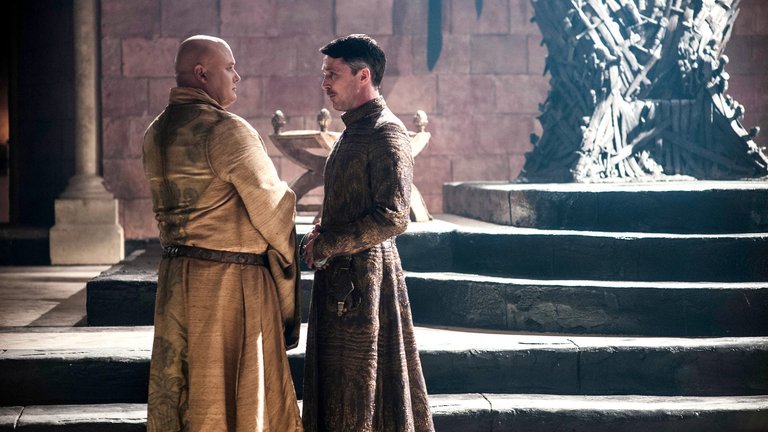
The episode’s most celebrated sequence, however, is a battle of wits in King’s Landing. Tywin Lannister executes his strategy of consolidation through marriage by compelling Lady Olenna Tyrell to agree to wed Loras to Cersei. This negotiation is a verbal masterpiece. Olenna parries Tywin’s blunt mention of Loras’s homosexuality with witty, thinly-veiled references to Cersei’s incest with Jaime. Tywin’s ultimate power play—threatening to appoint Loras to the Kingsguard, thereby extinguishing the Tyrell male line—forces Olenna’s pragmatic, if furious, concession. The consequences ripple out: Tyrion must bitterly inform Sansa of their own arranged marriage, and a subsequent confrontation with Cersei leads him to deduce it was Joffrey, not his sister, who tried to have him assassinated. The episode’s philosophical core is then laid bare in the conversation between Littlefinger and Varys. As Baelish prepares to depart for the Vale, he drops all pretence, describing his worldview to the Spider: chaos is not a threat to be feared, but a ladder to be climbed. He also coldly reveals the fate of his agent Ros, whom he gave to Joffrey to be murdered with a crossbow—a disposal of a loose end disguised as a tribute to the king’s sadism.
On a technical level, The Climb is impeccably constructed. Its writing is economical and its direction cohesive, successfully weaving an ever-more-complex web of subplots into a unified whole. The Wall sequence, while light on major plot development, serves as a formidable showcase for the series’ production ambition and special effects prowess.^1^
Yet, the episode is not without its criticisms. The structural necessity of ‘table-setting’ results in a pace that can feel glacial, with several threads offering minimal forward momentum. More problematically, some content choices edge into exploitative territory. Theon’s torture, by this sixth iteration, begins to feel gratuitous, crossing into a realm of torture porn that yields diminishing narrative returns. Similarly, the brutal killing of Ros—a character invented for the show—feels like hollow shock value. Her betrayal by Littlefinger is narratively predictable, and her graphic death serves little purpose beyond a violent, titillating set piece.
The episode’s true brilliance lies not in its physical climb, but in its ideological one. The scene between Varys and Littlefinger is its masterpiece. Here, Baelish is fully unveiled as a ruthless, ultra-Machiavellian operator, but the scene’s greater power is how it articulates the fundamental political dichotomy of Westeros. Varys champions order, tradition, and stability—a realm carefully maintained. Littlefinger espouses chaos and violence as the necessary catalysts for ascent. This clash is the ideological engine of the series, and ‘The Climb’ presents it with stunning clarity. It is this philosophical weight, far more than the spectacle on the Wall, that grants the episode its lasting significance, reminding us that the most treacherous and consequential climbs are always those undertaken on the ladder of power.
RATING: 7/10 (+++)
Blog in Croatian https://draxblog.com
Blog in English https://draxreview.wordpress.com/
InLeo blog https://inleo.io/@drax.leo
LeoDex: https://leodex.io/?ref=drax
InLeo: https://inleo.io/signup?referral=drax.leo
Hiveonboard: https://hiveonboard.com?ref=drax
Rising Star game: https://www.risingstargame.com?referrer=drax
1Inch: https://1inch.exchange/#/r/0x83823d8CCB74F828148258BB4457642124b1328e
BTC donations: 1EWxiMiP6iiG9rger3NuUSd6HByaxQWafG
ETH donations: 0xB305F144323b99e6f8b1d66f5D7DE78B498C32A7
BCH donations: qpvxw0jax79lhmvlgcldkzpqanf03r9cjv8y6gtmk9