Television Review: The Collaborator (Star Trek: Deep Space Nine, S2x24, 1994)

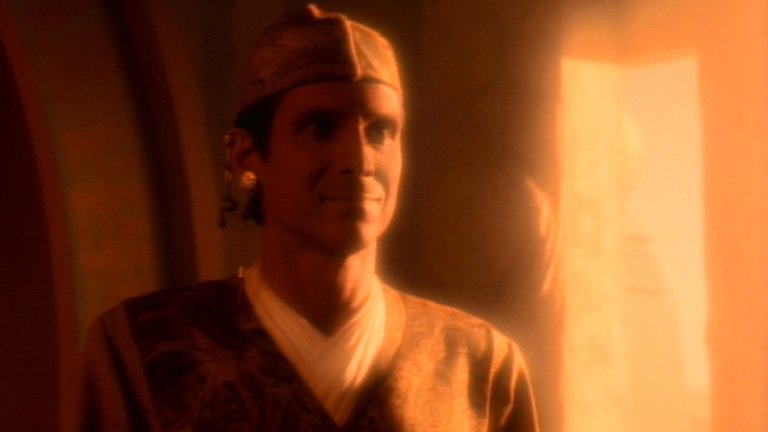
The Collaborator (S20E24)
Airdate: 22 May 1994
Written by: Gary Holland, Ira Steven Behr & Robert Hewitt Wolfe
Directed by: Cliff Bole
Running Time: 46 minutes
Star Trek: Deep Space Nine never shied away from carving its own path through the franchise's established conventions. Where The Next Generation offered a gleaming vision of 24th-century utopia, DS9 planted its flag firmly in the mud—quite literally, given its setting aboard a former Cardassian mining station. This darker tone, with its preoccupations for political scheming and religious complexity, occasionally gives the impression—particularly to younger viewers encountering the series retrospectively—that we're watching something closer to Game of Thrones than traditional science fiction. Nowhere is this more apparent than in The Collaborator, an episode whose plot could have been lifted from virtually any troubled period in human history, stripped of its trappings and laid bare as a story about power, betrayal, and the compromises good people make when circumstances demand them.
The episode centres on the selection of a new Kai—the spiritual leader of Bajor—roughly a year after the beloved Kai Opaka became stranded in the Gamma Quadrant. For Major Kira Nerys, the choice seems obvious: Vedek Bareil, her lover and a man of genuine spiritual conviction, represents everything she believes Bajor needs in its continued recovery from occupation. The alternative, Vedek Winn, is someone Kira despises with good reason; she holds Winn responsible for a previous assassination attempt on Bareil's life. Yet what begins as a straightforward contest soon reveals itself to be far more complicated than Kira could have anticipated.
Winn proves herself a formidable opponent through her calculated involvement in a case that threatens to derail Bareil's candidacy entirely. The matter concerns Kubus Oak (Bert Remsen), man who served as a high-ranking official in the Bajoran Occupation Government—that collaborationist body which helped the Cardassians procure labour for their mines and was directly or indirectly responsible for countless Bajoran deaths. Following the occupation's end, Kubus fled to Cardassia Prime, his name added to the list of prohibited persons barred from returning under the Ilvian Proclamation issued by the Bajoran Provisional Government. His unexpected arrival at Deep Space Nine results in immediate arrest by Constable Odo, whose motivations are partly protective; without official custody, Kubus might well face mob justice from those still nursing grievances.
Winn, however, sees opportunity where others see only a war criminal. She offers Kubus sanctuary within the Bajoran temple in exchange for information that could swing the Kai selection in her favour. The revelation concerns the Kendra Valley Massacre, in which forty-three Bajoran resistance fighters—including Kai Opaka's own son—were killed during the occupation. According to Kubus, the intelligence that led to their deaths came from none other than Vedek Bareil himself. Kira, devastated by the accusation yet refusing to believe it, launches her own investigation determined to clear Bareil's name.
The station crew's examination of historical records confirms what Kira desperately wishes weren't true: Bareil was indeed the informant. When she confronts him, Bareil admits everything. He explains that the alternative would have been Cardassian reprisals against thousands of innocent civilians—a massacre on an entirely different scale. Kira is shattered, and matters worsen when Bareil withdraws his candidacy, effectively guaranteeing Winn's ascension to Kai.
Yet Kira cannot leave it alone. Her continued digging uncovers inconsistencies that suggest Bareil, despite his confession, could not actually have been the traitor. The truth, when it finally emerges, is more devastating still: Bareil was covering for Kai Opaka herself. It was Opaka who provided the information to the Cardassians, fully aware that doing so would mean her son's death. Bareil's deception, he maintains, was necessary because Opaka remains too revered a figure; the truth would fracture Bajor at its most vulnerable moment. When Winn is ultimately elected, Kira and Bareil reconcile themselves to the outcome, even agreeing to pay respects to their new Kai—a conclusion that feels almost unbearably complex in its moral ambiguity.
Star Trek was conceived by a secular humanist, yet DS9 treats Bajoran religion with unexpected seriousness. Much of this episode unfolds through Bareil's orb visions—sequences directed with characteristic skill by veteran Cliff Bole. These dreamlike passages offer touches of surrealism, black humour, and even subtle eroticism, though they occasionally confuse more than illuminate. The details concerning Praylar Bek, the monk who committed suicide over his involvement in the treachery, feel somewhat extraneous to the central narrative.
Far more compelling is the screenplay by Greg Holland, Ira Steven Behr, and Robert Hewitt Wolfe, which adopts a pragmatic view of religion as a beneficial institution—the glue holding together a traumatised society. This utilitarian principle extends to numerous characters, including those like Bareil who supposedly represent Bajor's moral foundation yet justify deception when they deem it necessary. The same logic applies to Kubus, who defends his collaboration by arguing that without individuals like himself moderating Cardassian excess, Bajoran suffering would have been considerably worse. These competing perspectives render Bajor's political landscape genuinely multifaceted rather than simplistically heroic.
Behind the scenes, the production team deliberately delayed addressing the vacancy in Bajor's spiritual leadership for an entire year while debating whether Bareil or Winn should prevail. Initially, Bareil seemed the logical and "safe" choice. Ultimately, however, the writers recognised that a villainous, ruthless, and actively hostile religious leader would generate far more dramatic possibilities going forward. Louise Fletcher's formidable presence undoubtedly made this decision easier; her Winn radiates quiet menace in a way that Philip Anglim's more understated Bareil simply cannot match.
The episode also deserves mention for a quietly devastating moment in which Kira openly declares her love for Bareil—observed by Odo, whose pained expression establishes the recurring thread of his unrequited affection for her. This subplot would resonate through numerous subsequent episodes, adding emotional texture to the series' broader narrative.
The Collaborator may not rank among DS9's absolute finest episodes—its twists are somewhat predictable, and certain narrative threads feel underdeveloped. Nevertheless, it stands as solid, confident television that establishes crucial groundwork for future developments. In its willingness to embrace moral complexity and acknowledge that even the most principled individuals sometimes make terrible choices for reasons they believe justify the cost, the episode exemplifies what made Deep Space Nine distinctive within the Star Trek canon.
RATING: 6/10 (++)
Blog in Croatian https://draxblog.com
Blog in English https://draxreview.wordpress.com/
InLeo blog https://inleo.io/@drax.leo
Substack https://draxster.substack.com
LeoDex: https://leodex.io/?ref=drax
InLeo: https://inleo.io/signup?referral=drax.leo
Hiveonboard: https://hiveonboard.com?ref=drax
1Inch: https://1inch.exchange/#/r/0x83823d8CCB74F828148258BB4457642124b1328e
BTC donations: 1EWxiMiP6iiG9rger3NuUSd6HByaxQWafG
ETH donations: 0xB305F144323b99e6f8b1d66f5D7DE78B498C32A7
BCH donations: qpvxw0jax79lhmvlgcldkzpqanf03r9cjv8y6gtmk9