Television Review: The Gold Violin (Mad Men, S2x07, 2008)

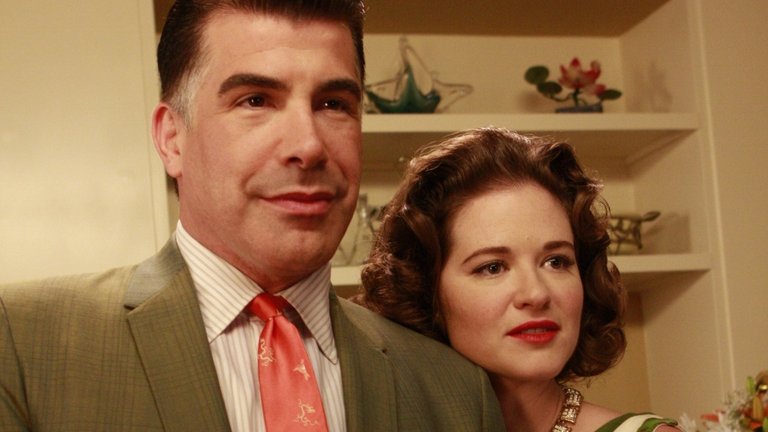
The Gold Violin (S2x07)
Airdate: 7 September 2008
Written by: Jane Anderson, Andre Jacquemott, Maria Jacquemott and Matthew Weiner
Directed by: Andrew Bernstein
Running Time: 48 minutes
The second season of Mad Men consciously depicts America in 1962 perched at the zenith of its post-war power. It is a moment of unparalleled prosperity and confidence, where President Kennedy’s New Frontier promises a future of limitless potential, still untainted by the assassinations, Vietnam, and civil unrest that would soon define the decade. It is unsurprising, then, that the season’s very midpoint—the seventh episode, pointedly titled The Golden Violin—opens with an image that symbolically presents its protagonist, Don Draper, at the very apex of this world.
The episode’s opening tableau is a brilliant example of the visual storytelling. Draper is seen in an immaculately austere car salon, sitting behind the wheel of a gleaming 1962 Cadillac Coupe de Ville. The vehicle is a totem of success, accessible only to the upper class. His ability to purchase it is the ultimate signifier that Dick Whitman has fully ‘made it’ as Don Draper. This ascension is verbally confirmed in a subsequent, quietly significant scene with the agency’s patriarch, Bertram Cooper. Informing Draper that he will now need to wear tuxedos more frequently and attend the social functions of decision-makers, Cooper effectively anoints him as a member of the ruling caste. Draper basks in this validation, proudly showing the car to his wife Betty and later using it to transport his picture-perfect family on an idyllic picnic. The Cadillac is the physical manifestation of his conquest—a mobile throne from which he surveys his kingdom.
Yet, this triumph is immediately and irrevocably shadowed by the ghosts of Draper’s past. The very act of entering the car dealership triggers a brief but potent flashback to roughly a decade earlier, where a younger, desperate Draper ekes out a living as a used car salesman. The shabbiness of that existence is starkly contrasted with the opulence before him. More chillingly, his office is visited by a mysterious woman (a haunting Melinda Page Hamilton) who delivers the devastating line: “I know you’re not Don Draper.” This intrusion shatters the pristine present, reminding both Draper and the audience that his entire edifice is built upon a stolen identity, a foundational lie that can never be fully buried.
The purchase of the Cadillac itself is born not from unadulterated triumph but from grim necessity; his previous car was totalled in a traffic accident that nearly killed him. The accident’s significance is compounded by the presence of Bobbie Barrett, with whom he was conducting an adulterous and increasingly toxic affair. Though Don has ended the relationship, its fallout pursues him relentlessly.
This pursuit crystallises in the episode’s central, agonising set piece at the Stork Club. Bobbie’s husband, the crude comedian Jimmy Barrett, uses a lucrative television deal brokered by Don as a pretext to insinuate himself into the Drapers’ lives. He invites Betty to a celebration, which she reluctantly attends with Don. In a scene dripping with malicious intent, Jimmy, while Don is distracted with Bobbie, deliberately plies Betty with alcohol and obliquely accuses Don of having an affair with his wife. Betty’s expression shifts from polite discomfort to dawning horror and finally to visceral disgust. The confrontation culminates with Jimmy directly spitting the accusation to Don about sleeping with his wife. The car journey home, meant to be a silent ride in Don’s new symbol of success, becomes a hearse for their marriage’s dignity, interrupted only by Betty vomiting onto the pristine upholstery. It is a moment of spectacular, symbolic wreckage; the American Dream, quite literally, cannot be stomached.
While Don’s personal life unravels, Sterling Cooper continues its awkward, corporate attempt to harness the coming cultural wave. The hiring of the younger creative team, Smithy Smith (Patrick Kavanaugh) and Kurt Smith (Edin Geli), represents this push. They belong to the Beat-influenced, rebellious generation and propose a revolutionary concept for Martinson’s Coffee: instead of dictating to youth, use a likeable jingle to make suggestions. Their success with previously sceptical clients highlights a seismic shift in advertising—and by extension, in society’s authority structures—that the old guard, for all their tuxedos, can scarcely comprehend.
A parallel shift in the office’s micro-politics unfolds around Don’s secretary, Jane Siegel. Defying Joan Holloway’s warnings about her wardrobe, she wears a sweater so provocative it prompts Roger Sterling to remark he would forbid his own daughter from wearing it. Later, overhearing junior executives anxiety over Bert Cooper’s habit of quizzing them about the painting in his office, Jane orchestrates a daring, clandestine raid to view it. The discovery that it is a Mark Rothko abstract expressionist work is a delicious irony, undercut moments later when Harry Crane, trying to appear cultured, mentions it to Cooper only to be told it means nothing to him—he bought it purely as an investment. This vignette perfectly captures the show’s critique: art, culture, and even rebellion are being commodified by the very establishment they ostensibly challenge. Jane’s initiative nearly costs her job, as Joan, who sees her as a threat, seizes the chance to fire her. In a twist of fate (or calculated desperation), Jane appeals to Roger, who, clearly attracted to her, overrules Joan and secures her return. The power dynamic subtly shifts; traditional, matriarchal authority (Joan) is circumvented by male caprice and sexual interest.
The episode’s title finds its origin in a subplot involving Ken Cosgrove, who has written a story inspired by an exhibit at the Museum of Modern Art. Art director Salvatore Romano, deeply moved by the story, invites Ken to dinner at his home. The scene is a masterpiece of tragicomic unease. Ken is impressed by the sophisticated décor and lavish spread, but Salvatore’s hospitality is entirely directed at his handsome colleague, leaving his wife Kitty utterly neglected and bewildered. The ‘gold violin’ of the title—a beautiful object perhaps more valuable than functional—becomes a metaphor for Salvatore’s own life: a meticulously constructed façade of heterosexual domesticity that hides his true, unplayable nature. The script for this storyline was co-written by Jane Anderson, a lesbian writer known for exploring homosexual themes, and her contribution lends the scene a palpable authenticity, rendering Salvatore’s closeted agony with both tragedy and dark humour.
The episode’s overarching strength is its systematic deconstruction of the American Dream. Don Draper appears to have it all: professional acclaim, a beautiful wife, flawless children, and now the ultimate luxury car. Yet every element is compromised. His success is built on fraud, his marriage is a hollow performance, his family is a prop, and the car is both a replacement for a wreck caused by his infidelity and the vessel for his wife’s physical revulsion. The idyllic picnic scene concludes with a telling period detail often cited by critics: as the family departs, they simply leave their litter—beer cans, rubbish—strewn on the grass. This complete disregard for the environment is not just a historical footnote; it is a metaphor for the moral and emotional detritus Don leaves in his wake. The dream is not merely fragile; it is inherently polluting.
The Gold Violin also seeds the coming social cataclysm with remarkable prescience. The two Smiths reference the Port Huron Statement, the founding manifesto of the Students for a Democratic Society (SDS), as a guide to what American youth wants. At the time, the SDS was an obscure, radical group. By the decade’s end, it would become a cornerstone of the New Left, fundamentally challenging the very institutions Sterling Cooper represents. The episode hints that the confident world of 1962 is already incubating the forces that will dismantle it.
Another nuanced period detail lies in Betty’s reaction to Jimmy Barrett. After his vicious stunt, she recoils with the pronouncement, “You people are ugly and crude.” When Jimmy retorts, “Comedians?”, the question hangs in the air. The remark could easily be read as a product of the residual, genteel anti-Semitism still lingering in the WASP circles from which Betty hails, a subtle bigotry as much a part of the ‘good old days’ as the Cadillacs and cocktails.
In the end, The Gold Violin stands out as one of Mad Men’s most perfectly realised episodes. It functions as a poignant, critical elegy for an America at its peak, cleverly using the purchase of a luxury car as the narrative engine to explore the corrosion beneath the chrome. It masterfully interweaves personal betrayal, professional anxiety, and social foreshadowing, all while maintaining the series’ signature aesthetic precision and narrative restraint.
RATING: 8/10 (+++)
==
Blog in Croatian https://draxblog.com
Blog in English https://draxreview.wordpress.com/
InLeo blog https://inleo.io/@drax.leo
LeoDex: https://leodex.io/?ref=drax
InLeo: https://inleo.io/signup?referral=drax.leo
Hiveonboard: https://hiveonboard.com?ref=drax
Rising Star game: https://www.risingstargame.com?referrer=drax
1Inch: https://1inch.exchange/#/r/0x83823d8CCB74F828148258BB4457642124b1328e
BTC donations: 1EWxiMiP6iiG9rger3NuUSd6HByaxQWafG
ETH donations: 0xB305F144323b99e6f8b1d66f5D7DE78B498C32A7
BCH donations: qpvxw0jax79lhmvlgcldkzpqanf03r9cjv8y6gtmk9