Television Review: The Mountain and the Viper (Game of Thrones, S4x08, 2014)

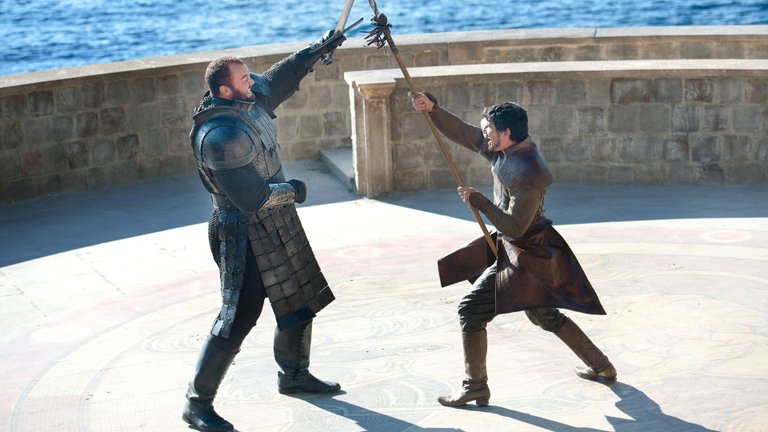
The Mountain and the Viper (S4x08)
Airdate: 1 June 2014
Written by: David Benioff & D.B. Weiss
Directed by: Alex Graves
Running Time: 52 minutes
By the culmination of its fourth season, Game of Thrones stood at a pivotal and perilous crossroads. Showrunners David Benioff and D.B. Weiss, increasingly cognisant that the television narrative would irrevocably diverge from George R.R. Martin’s unfinished literary source material, grew bolder in their plot deviations. Yet this creative ambition was simultaneously shackled by a paramount commercial consideration: the imperative that each episode conclude with a ratings-friendly ‘wham’ moment or cliffhanger. Maintaining this balance—between novelistic complexity and televisual punch—was a task Benioff and Weiss found increasingly difficult to accomplish. The result was a creeping influx of narrative clichés, character simplifications, and consequent plot holes that would metastasise and ultimately plague the series until its ignominious end. Many of these nascent flaws are starkly observable in the otherwise brilliantly executed eighth episode of season four, pointedly titled The Mountain and the Viper. The episode is a microcosm of the show’s winning formula and its gathering storm clouds, a spectacular set piece built upon foundations that are beginning to show alarming signs of sand.
True to the series’ structural template, the episode’s titular event—the grand trial by combat to decide Tyrion Lannister’s fate—is reserved for the final act. The preceding fifty minutes are devoted to servicing disparate storylines scattered across the map of Westeros and beyond, a narrative juggling act that yields mixed results. In Meereen, a subplot of genuine pathos unfolds as Ser Barristan Selmy presents Daenerys Targaryen with the late King Robert’s decree pardoning her advisor, Ser Jorah Mormont, irrefutable evidence of his initial espionage. Daenerys’s subsequent banishment of Jorah is a brilliantly staged scene of heartbreak and betrayal, with Iain Glen’s performance masterfully eliciting sympathy for a man whose past sins finally ensnare him. It is a rare instance where the show’s compression of book material retains its emotional and thematic weight.
Conversely, the episode’s handling of events in the North and the Vale reveals the writers’ growing propensity for simplification and fan service. The wildling raid on Mole’s Town, depicted with visceral brutality, serves its primary narrative function: to illustrate the imminent threat to the Night’s Watch and to further the estrangement between the now-dead Ygritte and Jon Snow. However, the showrunners, perhaps seeking to sweeten a bit the]relentless darkness of the series, invent a moment where Ygritte spares Gilly and her infant son. While intended to add a sliver of moral ambiguity to the fiery wildling, it feels like a contrived nod to conventional heroism, a softening of the world’s hard edges that Martin’s text would rarely countenance.
Far more problematic are the alterations to the aftermath of Lysa Arryn’s death at the Eyrie. In Martin’s novels, Petyr Baelish goes through a labyrinth of deception, employing a convenient scapegoat while Sansa Stark remains concealed under the alias of his bastard daughter. Here, this elaborate scheme is drastically simplified. Sansa not only reveals her true identity to the Lords Declarant but delivers a testimony that, with only minor omissions, secures Baelish’s position as Lord Protector. The implication—that an inexperienced, traumatised girl suddenly morphs into a super-efficient ‘player’ who impresses even the master manipulator Littlefinger—is a character leap of staggering audacity. It prioritises a moment of audience-pleasing agency over psychological consistency, a portent of the erratic characterisation that would blight later seasons.
This trend towards manufactured, often jarring, character beats is further evidenced in Essos. The scene depicting Grey Worm and his Unsullied bathing, only for him to lock eyes with Missandei, is a pure television invention. It heavily implies a sexual attraction that, given the Unsullied’s famously thorough castration practices, borders on the biologically implausible. The subsequent conversation where Missandei reassures Daenerys about the efficacy of Essosi eunuch-making feels less like organic world-building and more like clumsy retroactive justification. The implied romance between two of the series’ only major actors of colour often registered as a hollow attempt to fill perceived diversity quotas, a box-ticking exercise masquerading as character development.
The most narratively stagnant thread is that of Theon Greyjoy, now the broken ‘Reek’. His mission to secure the surrender of the Ironborn at Moat Cailin for Ramsay Snow is a functional piece of plot machinery. It succeeds in its sole purpose: to facilitate Ramsay’s reward—legitimisation as Ramsay Bolton—and the Boltons’ ascent to Wardens of the North. It is grim, effective, but ultimately a subplot running on thematic autopilot.
Similarly, the journey of the Hound and Arya Stark reaches another dead end at the Bloody Gate of the Eyrie. Upon learning of her aunt’s death, Arya’s reaction—a burst of hysterical, ironic laughter—is a powerful character moment born of cumulative trauma. It underscores the cruel futility that defines her journey, a theme that finds its philosophical echo in the episode’s most debated original scene.
In the black cells of King’s Landing, as Tyrion awaits his fate, he shares a final drink with his brother Jaime. Their conversation turns to their simple-minded cousin, Orson Lannister, who spent his days obsessively crushing beetles with a rock. This nearly four-minute digression, entirely invented for the show, has no counterpart in Martin’s novels. Tyrion recounts his childhood obsession with understanding why Orson committed this endless, senseless slaughter, but could never divine a reason. The scene, as the writers later explained, was intended to show Tyrion’s mind grappling with the random, inexplicable brutality of the world as he faces his own potential annihilation. Its execution, however, is polarising. Critics and fans noted its clear resemblance to a famous scene in Stanley Kubrick’s Paths of Glory, where a condemned soldier muses on the indifference of fate before a cockroach is casually crushed. Benioff and Weiss, avowed fans of the film, likely drew direct inspiration. Yet, the length and abstract nature of the monologue risked self-indulgence. Furthermore, it spawned fan theories that the character ‘Orson’ was an unsubtle jab at author Orson Scott Card, a noted critic of the series—a meta-textual reading that, whether intended or not, distracted from the scene’s thematic purpose.
All these threads converge, as they must, on the trial by combat. Directed by Alex Graves and shot in the gruelling heat of Dubrovnik, the duel between Prince Oberyn ‘the Red Viper’ Martell and Ser Gregor ‘the Mountain’ Clegane is, without question, a masterclass in televised action.It is the most spectacular single combat the series had produced to that point, a perfect alchemy of choreography, drama, and visceral gore that defined Game of Thrones at its peak.Graves expertly builds tension, contrasting Oberyn’s fluid, acrobatic spearmanship against the Mountain’s brute, plate-armoured force. The Viper’s strategy—forgoing armour for mobility, using a light spear to bleed his colossal opponent—appears triumphant. For a glorious, agonising moment, the show teases a radical departure: the heroic, charismatic outsider poised to win, to secure justice for his murdered sister and save the beloved Tyrion. Oberyn, embodying Dornish liberalism and a progressive, sexually open ethos, was a character crafted for audience adoration. In most television series, he would have prevailed.
But this is Game of Thrones, and the episode delivers its mandated ‘wham’ moment with devastating brutality. Oberyn’s overconfidence—his need to hear a confession rather than secure the kill—proves fatal. In a reversal as shocking as it is graphic, the Mountain pulls him down, gouges out his eyes, and confesses to murdering Elia before crushing Oberyn’s skull with his bare hands. It is a moment of unparalleled horror and narrative audacity, a stark reminder of the show’s core ethos: in this world, heroism is no armour against nihilistic violence. The sequence is technically flawless and emotionally shattering, a cliffhanger of the highest order.
Yet, this critical triumph also exposes the structural dilemma Benioff and Weiss faced. The duel’s outcome is not a flaw; it is brilliant, faithful to the source material’s ruthless spirit. The flaw lies in the ecosystem that necessitated it. The entire episode’s architecture is engineered to service this climax. The preceding scenes, while varied in quality, primarily function as narrative placeholders, marking time until the main event. The character simplifications in the Vale, the contrived romance in Meereen, the thematic heavy-handedness of the beetle monologue—all can be seen as symptoms of a production increasingly prioritising momentum and spectacle over cohesive, patient storytelling. The ‘wham’ moment is earned through directorial prowess and performative intensity, but the path to it is increasingly paved with compromises.
The Mountain and the Viper thus stands as a magnificent paradox: one of the series’ most electrifying and memorable episodes, yet one that clearly signals the unsustainable pressures shaping its future. It delivers a masterful payoff while demonstrating the cost of the narrative shortcuts required to set the stage. The episode is a thrilling, brutal, and ultimately pyrrhic victory—a landmark moment in television that, upon closer inspection, reveals the very cracks that would, season by season, cause the entire edifice to crumble.
RATING: 6/10 (++)
==
Blog in Croatian https://draxblog.com
Blog in English https://draxreview.wordpress.com/
InLeo blog https://inleo.io/@drax.leo
LeoDex: https://leodex.io/?ref=drax
InLeo: https://inleo.io/signup?referral=drax.leo
Hiveonboard: https://hiveonboard.com?ref=drax
Rising Star game: https://www.risingstargame.com?referrer=drax
1Inch: https://1inch.exchange/#/r/0x83823d8CCB74F828148258BB4457642124b1328e
BTC donations: 1EWxiMiP6iiG9rger3NuUSd6HByaxQWafG
ETH donations: 0xB305F144323b99e6f8b1d66f5D7DE78B498C32A7
BCH donations: qpvxw0jax79lhmvlgcldkzpqanf03r9cjv8y6gtmk9