Television Review: The New Girl (Mad Men, S2x05, 2008)

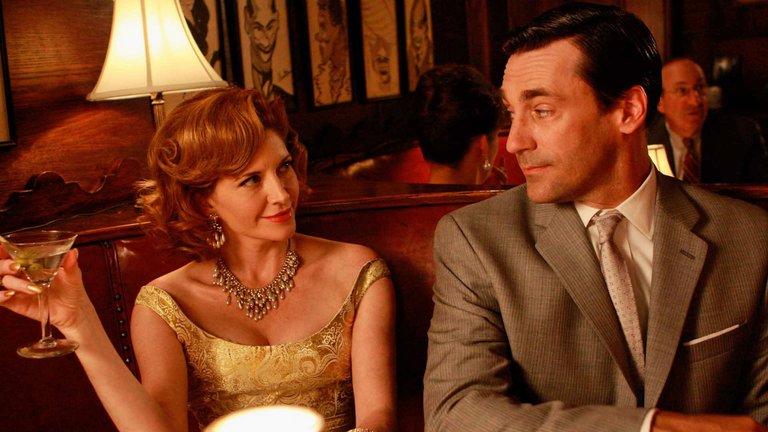
The New Girl (S2x05)
Airdate: 24 August 2008
Written by: Robin Veith
Directed by: Jennifer Getzinger
Running Time: 48 minutes
The so-called Golden Age of Television established a peculiar and remarkable artistic principle: the most prestigious dramas excelled at making the mundane utterly compelling. They demonstrated that a show need not rely on car chases, gunfights, or high-stakes melodrama to captivate; instead, the quiet dissection of character in everyday scenarios could yield profound dramatic power. Matthew Weiner’s Mad Men stands as a quintessential exemplar of this school, and its second season episode, The New Girl (Season 2, Episode 5), is a great example pof the form. On its surface, the episode is a slow-burning account of office politics and a mid-summer personal misadventure. Yet, through its meticulously observed details and understated performances, it delivers brilliant character exposition, excavates traumatic pasts, and whispers of the profound social tremors just beginning to ripple through the ostensibly stable world of 1962.
The episode’s title operates on a double entendre. It directly refers to Jane Sigel (Peyton List), the young, college-educated woman recently installed as Don Draper’s secretary. It is high summer in New York, and Jane uses the heat as a pretext for a more casual, revealing wardrobe. The male staff’s attention becomes palpably predatory, a silent, leering audience to her daily performance. This provokes one of the episode’s most fascinating power struggles. Joan Holloway, temporarily covering the role and freshly adorned with an engagement ring, swiftly reasserts her matriarchal authority over the office’s feminine ecosystem. Her chastisement of Jane is not merely about professionalism or decorum; it is a brutal lesson in survival. Joan understands the economy of female sexuality in this world—it is a currency to be strategically deployed, not frivolously spent. By demanding “wholesome” costume choices, she is teaching Jane the first rule: to be taken seriously, a woman must first learn to armour herself against the male gaze she is simultaneously expected to attract.
While Jane goes through this initiation, the episode’s central narrative thrust follows Don Draper into a spiral of recklessness that exposes his profound disquiet. He is being aggressively pursued by Bobbie Barrett, the brash wife of comedian Jimmy Barrett, who is intent on continuing their affair. Under the guise of celebrating her husband’s television deal, she lures Don to the upscale Sardi’s restaurant in the middle of a working day. There, in her most glamorous and seductive attire, she embodies a very different model of female agency from Joan’s—one of overt, transactional sexual power. The encounter turns acutely awkward with the arrival of Rachel Menken and her new husband. This chance meeting is a superb piece of writing, forcing Don and Rachel to confront the ghost of their past, deeply felt affair amidst the banal politeness of a restaurant greeting. The shared, unspoken discomfort highlights the lingering emotional truth beneath Don’s carefully constructed façade.
The plot accelerates from discomfort into outright chaos. Fuelled by alcohol and Bobbie’s proposition of a sexual tryst in the sand at Long Beach, Don agrees to drive them out of the city. Their mutual intoxication leads to a loss of control, a car veering off the road, and minor injuries for both. For Don, the physical bruises are inconsequential compared to the social peril: being charged with drunk driving by local police and lacking the $150 cash for the fine. In a moment of sheer desperation, he makes a phone call that defines one of the series’ most crucial relationships: he calls Peggy Olson (Elisabeth Moss). Peggy’s response is a quiet triumph. She arrives with her own money, orchestrates a rental car for Don, and takes the battered Bobbie back to her apartment to hide until facial wounds can be concealed. The subsequent scene between the two women is electric. Bobbie, a veteran of managing men in the entertainment business, offers Peggy unsentimental career advice. She should treat men as equals, but use her femininity as a tool. It’s a cynical, pragmatic credo that stands in stark contrast to both Joan’s strategic armour and Jane’s naïve display, presenting a third path of calculated performance.
The aftermath of this night reverberates through Don’s life. He concocts a lie for Betty about side effects from blood pressure medication, a flimsy cover that underscores the growing chasm in their marriage. Back at the office, his arm in a sling, he is subjected to the grotesque spectacle of Jimmy Barrett arriving with Bobbie to personally thank him for the TV show deal. Don’s palpable anxiety—wondering if the comedian knows the truth—is a masterpiece of silent acting from Jon Hamm. The episode’s most significant character beat, however, comes when Don, with immense embarrassment, reimburses Peggy. Her simple, deliberate use of “Don” instead of “Mr. Draper” as she accepts the money is a seismic shift. It is an unspoken acknowledgement of the debt incurred, a move from hierarchical formality to a fraught, intimate parity forged in crisis.
This bond is further rooted in the episode’s harrowing flashbacks, set in 1960. We see Peggy in the aftermath of giving birth, heavily sedated in St. Mary’s hospital, implying a severe post-partum psychotic episode. The portrayal is unflinching and bleak. When Don visits, making awkward inquiries before realising the truth, he is visibly shaken. In a moment of rare, unguarded connection, he unconsciously sees his own traumatic past—the forged identity, the buried pain—mirrored in her experience. His advice, “You must put this behind you,” is less a corporate mantra and more a survival tactic he himself employs daily. This shared secret becomes the bedrock of their unique, enduring alliance, elevating their professional relationship to a level of unspoken understanding no other character shares.
For all its strengths, The New Girl, written by Robin Veith, is not a flawless piece of television. The episode suffers from a slight lack of narrative focus, primarily due to a subplot involving Pete and Trudy Campbell’s attempts to conceive. The storyline, in which Pete must prove his fertility by providing a sperm sample in the office while perusing erotic magazines, feels tonally adrift. Whether period-accurate or not, it plays like a piece of early-21st-century low-brow comedy awkwardly grafted onto the series’ refined aesthetic. Similarly, the bizarre interlude where Freddy Rumsen interrupts Jane and Ken Cosgrove to perform Mozart’s Eine kleine Nachtmusik with his trousers zipper is pure, absurdist farce. While it might aim to illustrate the juvenile office culture, it risks undermining the episode’s otherwise nuanced atmosphere with a jarring, cartoonish gag.
In the broader context of Mad Men’s second season, as noted in contemporaneous reviews, 1962 is presented as a year on the cusp. The world is still strong, confident and optimistic, yet the show subtly seeds the coming revolutions in gender, race, and social more. The New Girl encapsulates this perfectly. It is an episode about women navigating a man’s world using vastly different strategies—Jane’s naivety, Joan’s governance, Bobbie’s manipulation, Peggy’s quiet competence. It is about Don Draper, the archetypal self-made man, finding himself literally and metaphorically crashed by the forces of desire and indiscretion he believes he controls. By weaving together the mundane—a secretary’s dress, a traffic fine, an office prank—with moments of deep psychological revelation, the episode affirms Mad Men’s central genius: the greatest dramas often unfold not in war rooms or courtrooms, but in the quiet, charged spaces between people, where the future is being nervously, awkwardly, and irrevocably born.
RATING: 7/10 (+++)
==
Blog in Croatian https://draxblog.com
Blog in English https://draxreview.wordpress.com/
InLeo blog https://inleo.io/@drax.leo
LeoDex: https://leodex.io/?ref=drax
InLeo: https://inleo.io/signup?referral=drax.leo
Hiveonboard: https://hiveonboard.com?ref=drax
Rising Star game: https://www.risingstargame.com?referrer=drax
1Inch: https://1inch.exchange/#/r/0x83823d8CCB74F828148258BB4457642124b1328e
BTC donations: 1EWxiMiP6iiG9rger3NuUSd6HByaxQWafG
ETH donations: 0xB305F144323b99e6f8b1d66f5D7DE78B498C32A7
BCH donations: qpvxw0jax79lhmvlgcldkzpqanf03r9cjv8y6gtmk9