Television Review: The Wheel (Mad Men, S1x13, 2007)

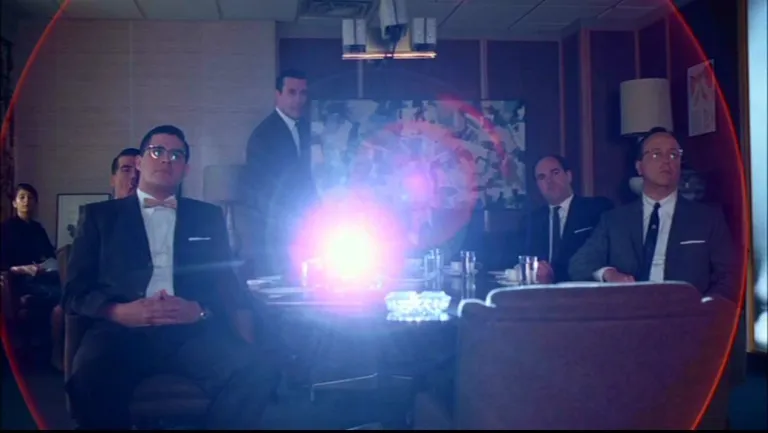
The Wheel (S1x13)
Airdate: 18 October 2007
Written by: Matthew Weiner & Robin Veith
Directed by: Matthew Weiner
Running Time: 52 minutes
In the contemporary landscape of prestigious television drama, a now‑common structural gambit sees the season’s most defining, explosive moments reserved for the penultimate episode. This practice, whilst often delivering a powerful immediate punch, carries a significant risk: the actual season finale can appear weak, underwhelming and inconsequential by comparison. This is precisely the trap into which Mad Men’s first season falls. The brilliance of Nixon vs. Kennedy – an episode of profound political and personal upheaval – is replaced by the more pedestrian, conventional The Wheel. The contrast renders the final chapter of an otherwise superb season a curiously flat and anti‑climactic affair, a competent piece of television that nevertheless fails to match the heights of what came immediately before it.
The plot of The Wheel unfolds several weeks after the momentous events of the previous episode: the 1960 presidential election and Don Draper’s securing of his partnership at Sterling Cooper by fending off Pete Campbell’s blackmail attempt. The episode is largely concerned with the aftermath, showing characters grappling with the new status quo.
The Draper family is supposed to reunite with Betty’s family for Thanksgiving, but Don is adamant in his refusal to attend, citing work pressures. At the office, he receives the shattering news that his brother, Adam, has committed suicide. Simultaneously, he learns that Rachel Menken, with whom he shared a genuine connection, is embarking on a three‑month world trip; a call from her father to Bert Cooper is interpreted as a not‑so‑subtle hint that their affair is conclusively over. Plunged into acute loneliness, Don channels this desolation into professional inspiration, crafting the legendary pitch for Kodak’s new Carousel slide projector. Using slides of his own family, he sells a nostalgic, aching vision of ‘the wheel’ of time and memory, securing Kodak as a client in a moment of triumphant artifice.
Whilst Don triumphs professionally, the episode pointedly contrasts his success with the personal suffering of others. Harry Crane, having attempted honesty by confessing his one‑night stand with Hildy to his wife, is banished to the office. Watching the happy images of the Drapers during Don’s presentation, he breaks down in tears – a stark reminder that the perfect family tableau is a marketable fiction. Pete Campbell, meanwhile, operates under intense pressure to save his job. His humiliation is complete when he must accept help from his father‑in‑law, who uses old connections to secure the Clearasil account. Don assigns the newly promoted junior copywriter, Peggy Olson, to handle it, compounding Pete’s emasculation. His frustration finds solace only in drink, much to his wife Trudy’s displeasure.
The domestic sphere offers no sanctuary either. Betty Draper’s storyline takes a decisive turn when her friend Francine arrives to complain about her husband Carlton’s affair, discovered via Manhattan numbers on a phone bill. Betty, harbouring her own suspicions, tests a Manhattan number from her own bill only to discover it belongs to her psychiatrist, Dr. Wayne, who has been colluding with Don. This betrayal – deeper than mere infidelity – prompts her to begin deliberately feeding suspicions to the psychiatrist, knowing they will be passed to her husband, a quiet act of marital warfare.
Peggy’s arc culminates in the episode’s most conventionally dramatic ‘wham’ moment. Having finally been promoted and given an office, albeit shared with the grumpy Victor Manny (Jonathan Spencer), her triumph is undercut by severe stomach pains. Rushed to hospital, she and the attending doctors are stunned to discover she is not only pregnant but entering labour. In a chilling, ambiguous moment after the birth, she turns away when offered the chance to hold her baby. This plot twist, whilst undeniably powerful, feels like a more traditional season‑ender, a cliffhanger setting up the career‑versus‑family dilemma that will define her character in subsequent seasons.
The episode concludes on a masterfully melancholy note of self‑deception. Don returns home and agrees to join Betty and the children for Thanksgiving, appearing to choose family. The final shot reveals this to be a fantasy; the season ends with Don utterly alone in his dark, empty house. This conclusion underscores the episode’s central theme: the gap between the lives we curate, both for clients and for ourselves, and the desolate reality we inhabit.
The Wheel, co‑written by Matthew Weiner and Robin Veith and marking Weiner’s directorial debut for the series (it would later earn both an Emmy nomination), is a finale of intriguing contradictions. It is both conventional and unconventional. Its unconventionality lies in its refusal to deliver major, plot‑driven resolutions for its protagonist. Don experiences a kind of epiphany – shaken by his brother’s death and Rachel’s departure, he seems to realise that his constructed life with Betty might be preferable to yet another reinvention. Yet, in a cruel irony, Betty is simultaneously learning the extent of his deceptions and beginning her emotional withdrawal, sowing the seeds of the marital collapse that will unfold in later seasons. The finale thus trades explosive action for poignant, character‑based irony.
However, some of its choices feel less assured. The scene between Betty and the young boy, Glenn Bishop, in which she discusses his private troubles, remains awkward and has long been criticised as an indulgence for Weiner’s son, who played the role. It adds little to the episode’s thematic weight. Furthermore, whilst Peggy’s secret pregnancy is handled with the show’s typical subtlety – the self‑delusion of a woman focused on career over family is psychologically plausible – its revelation as a last‑act shock inevitably feels like a concession to more conventional serialised storytelling. It is the kind of dramatic punctuation mark the show was often wise to avoid.
First season of Mad Men is a superb and fascinating recreation of the past’ with fascinating characters’ while noting a lack of traditional plot. The Wheel encapsulates these strengths and weaknesses. It is a character study steeped in period detail and psychological nuance, yet its plot mechanics, especially when compared to the seismic shifts of Nixon vs. Kennedy, can feel slight. The season’s overall excellence is isn’t drastically diminished with The Wheel, but the episode functions as the season’s least essential chapter.
RATING: 7/10 (+++)
==
Blog in Croatian https://draxblog.com
Blog in English https://draxreview.wordpress.com/
InLeo blog https://inleo.io/@drax.leo
LeoDex: https://leodex.io/?ref=drax
InLeo: https://inleo.io/signup?referral=drax.leo
Hiveonboard: https://hiveonboard.com?ref=drax
Rising Star game: https://www.risingstargame.com?referrer=drax
1Inch: https://1inch.exchange/#/r/0x83823d8CCB74F828148258BB4457642124b1328e
BTC donations: 1EWxiMiP6iiG9rger3NuUSd6HByaxQWafG
ETH donations: 0xB305F144323b99e6f8b1d66f5D7DE78B498C32A7
BCH donations: qpvxw0jax79lhmvlgcldkzpqanf03r9cjv8y6gtmk9