Television Review: Three Sundays (Mad Men, S3x04, 2008)

Three Sundays (S2x04)
Airdate: 17 August 2008
Written by: Andre Jacquemott & Maria Jacquemott
Directed by: Tim Hunter
Running Time: 48 minutes
The structural rhythm of Mad Men has often been described as episodic vignette, a series of finely observed “day in the life” slices that advance the overarching plot with deliberate, often glacial, slowness. Each episode typically confines itself to a narrow temporal window, deepening character through mundane ritual and subtle interaction rather than through sweeping narrative leaps. Three Sundays, the fourth episode of the second season, represents a slight but significant deviation from this established pattern. As the title overtly signals, the episode’s plot is spread across three consecutive Sundays—Passion Sunday, Palm Sunday, and Easter Sunday—encompassing the period between 8 April and 22 April 1962. This tripartite structure allows the writers, Andre and Maria Jacquemetton, to trace the gradual accumulation of pressure and revelation in their characters’ lives with a novel sense of weekly ritual, using the Christian liturgical calendar as both a narrative scaffold and a potent source of thematic resonance.
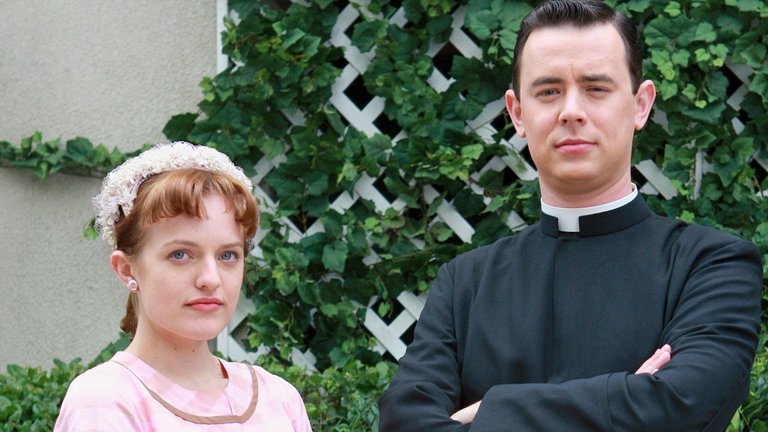
The choice of Eastertide is far from incidental; it ensures that questions of faith, guilt, redemption, and resurrection permeate the storylines. The episode is bookended by the high holy days of Christianity, and the script deftly explores how these abstract concepts collide with the messy, secular realities of early 1960s America. The most explicit engagement with faith is found in the storyline centred on Peggy Olson. Visiting her devoutly Catholic family for Sunday dinner, Peggy is pressured into attending Mass, an experience that visibly discomforts her. Her flight from the service—feigning illness—leads her to a chance encounter outside the church with Father Gill (Colin Hanks), a young, tall, and disarmingly handsome priest. In a beautifully ironic twist, his earnest, unintentionally charismatic presence inadvertently draws her back into the fold, setting in motion a complex dynamic that blends spiritual guidance with unspoken attraction and professional exchange.
Father Gill’s subsequent visit to the Olson home, where he learns of Peggy’s career as a copywriter on Madison Avenue, allows the episode to forge a fascinating connection between the pulpit and the pitch meeting. He recruits her to help craft his Palm Sunday sermon, a request that Peggy, ever eager to prove her utility and perhaps intrigued by the priest, accepts. This collaboration culminates in one of the episode’s most quietly devastating moments: during confession, Peggy’s sister Anita confesses to Father Gill that she “hates” Peggy. Anita, who has followed the traditional path of marriage and motherhood, seethes with resentment that Peggy, who bore a child out of wedlock, has simply abandoned that life for a career and acts like nothing happened. The Church, traditionally a bastion of the very morality Anita embodies, is here represented by a priest who is not a figure of judgement but of confused, slightly hip compassion. His final gesture—giving Peggy a painted Easter egg “for the little one” on Easter Sunday—is a masterpiece of ambiguous kindness. It is both a recognition of her secret and a gentle, painful reminder of the life she has chosen to suppress, highlighting the impossible gap between her modern aspirations and her family’s (and faith’s) traditional expectations.
Whilst Peggy grapples with the personal implications of faith and family, Don Draper is embroiled in a professional crisis that mirrors the episode’s themes of disaster and forced resurrection. Sterling Cooper is tasked with salvaging the American Airlines account after a recent, devastating air crash. The assignment is a public relations nightmare, and the pressure is ratcheted up when Duck Phillips informs Don that the airline wants concepts before Easter. This forces Don to summon his creative team for an emergency meeting on Palm Sunday—a violation of the Sabbath that underscores the agency’s secular devotion to commerce. The scenes of the team working in a near-deserted office are among the episode’s most striking visual departures; the men, usually icons of tailored perfection, are dressed in casual sweaters, slacks, and even shorts, creating a comical yet revealing contrast. Their dishabille mirrors their mental state—stripped of their professional armour, they are forced to think rawly. Don’s solution, when it comes, is pure Draper alchemy: to ignore the disaster entirely and pitch a future-oriented campaign asking “what 1963 will look like.” It is an act of audacious denial, a secular form of resurrection. Yet, in a cruel twist of corporate fate, Don’s perfect pitch is rendered useless when Duck reveals that Shel Keneally, their key contact at American Airlines, has been fired. The executives will attend the meeting merely out of courtesy. Don’s creative resurrection is stillborn, and his bitter reaction contrasts sharply with Roger Sterling’s world-weary consolation that “these things happen.”
Don’s professional frustration is expertly paralleled with his domestic turmoil. Most of this stems from his five-year-old son, Bobby (now played by Aaron Hart), whose childish irresponsibility causes minor but resonant chaos. Betty, overwhelmed and increasingly detached, demands that Don discipline his son. Don’s refusal, and his subsequent, raw admission to Betty, provides one of the season’s most poignant character insights: he confesses that he was savagely beaten by his own father and cannot bring himself to replicate that violence. This moment fractures the façade of Don as the omnipotent patriarch, revealing the traumatised child within who is desperately trying to forge a different, better fatherhood—even if he has no model for how to do so.
The episode’s focus on these two major arcs is disciplined, but it allows minor storylines to weave through the narrative with natural ease. Bobbie Barrett appears at Don’s office, using a flimsy business pretext to reignite their affair, highlighting Don’s continued moral drift. More notably, Roger Sterling, preoccupied with his daughter’s upcoming wedding, encounters a call girl named Vicky (Marguerite Moreau) in a hotel bar. Impressed by her brazen resourcefulness (she poses as a client’s wife to dine in a restaurant), he hires her services. In a telling moment of self-rationalisation, Roger tells Vicky he hasn’t been with a prostitute since his Navy days, framing this transaction as a tidier, less emotionally fraught alternative to an affair. It’s a sad, funny commentary on the compartmentalisation of his life, and the actor John Slattery delivers the line with perfectly dry irony, especially when Vicky dismisses his health concerns by stating “nobody ever died doing this,” prompting Roger’s wry smile at the memory of his own near-fatal heart attack.
The episode’s strength lies in this nuanced, structurally sound scripting and its acute sensitivity to the cultural shifts of its time. 1962 represents a pivotal moment where the old, established world begins to subtly erode. Peggy Olson is the embodiment of this change—a woman prioritising career over family in an era where such a choice was socially anathema. The episode cleverly contrasts her with the older, plainer, more “square” women in her family, framing the conflict not as a simple battle between progressive and conservative, but as a more tragic clash of mutually incomprehensible life paths. The casting of the youthful, attractive Colin Hanks as Father Gill adds a fascinating twist: the Church, the institution most associated with tradition, is here represented by a face that looks almost cool, blurring the lines and suggesting that even organised religion is not immune to the changing tides.
The use of humour is equally deft. Kiernan Shipka, as Sally Draper, steals her scenes with a child’s unfiltered curiosity, asking awkward questions and even sipping a cocktail in Sterling Cooper’s offices—a moment that is both charming and faintly unsettling. The visual joke of the creative team in casual weekend wear punctures the series’ usual aesthetic of rigid formality, reminding us that beneath the suits and slicked hair are fallible, tired men.
Three Sundays is a particularly finely crafted episode. It uses its expanded timeframe to explore themes of sacrifice, failure, and the hope for renewal—both personal and professional—against the backdrop of a fading, yet still potent, American Protestant ethic. It doesn’t advance the season’s plot in giant leaps, but in doing so it offers something richer: a profound, moving, and critically astute examination of its characters straining against the confines of their era, their faith, and their own deeply flawed natures.
RATING: 7/10 (+++)
==
Blog in Croatian https://draxblog.com
Blog in English https://draxreview.wordpress.com/
InLeo blog https://inleo.io/@drax.leo
LeoDex: https://leodex.io/?ref=drax
InLeo: https://inleo.io/signup?referral=drax.leo
Hiveonboard: https://hiveonboard.com?ref=drax
Rising Star game: https://www.risingstargame.com?referrer=drax
1Inch: https://1inch.exchange/#/r/0x83823d8CCB74F828148258BB4457642124b1328e
BTC donations: 1EWxiMiP6iiG9rger3NuUSd6HByaxQWafG
ETH donations: 0xB305F144323b99e6f8b1d66f5D7DE78B498C32A7
BCH donations: qpvxw0jax79lhmvlgcldkzpqanf03r9cjv8y6gtmk9