From Posts to Collectibles: Building the Baby Ladyverse Inside MemeHive

There is a difference between simply posting content on a blockchain and actually building something that belongs there.
That distinction has become increasingly important to me as I have spent more time on Hive.
When Baby Lady first began establishing a presence here, the immediate goal was relatively straightforward: publish our stories, educational essays, artwork, videos, and ideas somewhere that treated those creations differently from an ordinary social-media post.
Hive offered something valuable from the beginning. A post was not merely another piece of content dropped into an algorithmic timeline. It became part of a decentralized record. People could discover it, vote on it, comment on it, reference it later, and interact with the creator without everything depending upon a single centralized platform deciding whether the content deserved visibility.
That alone was compelling.
But something else has been happening.
The deeper I travel into Hive, the more I realize that the blockchain is not simply another location where the Baby Ladyverse can publish.
Hive can become part of the Baby Ladyverse itself.
And MemeHive, in particular, has opened an interesting door.
We have already started experimenting with NFTs here. We created the first pieces, put them into the market, and then something happened that matters much more to me than simply minting another digital collectible:
someone actually bought one.
That may sound like a small event.
I don't think it is.
Because when somebody purchases one of these NFTs, they are doing something fundamentally different from clicking a heart, leaving an upvote, or scrolling past an image.
They are choosing to become the permanent holder of a piece of the story.
And that has caused me to rethink what the Baby Ladyverse NFT presence on Hive should become.
This essay is about that next experiment.
Not another episode of the existing Baby Lady educational essay series.
Not another chapter in one of our established storylines.
This is something separate.
This is about turning the culture we are building on Hive into collectible characters, artifacts, memories and eventually an expanding visual archive of the Baby Ladyverse itself.

The First Experiment
Our first MemeHive NFTs were deliberately different from the NFTs we have created elsewhere.
The first was:
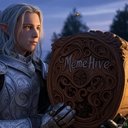
#001 — Keeper of the MemeHive
The concept was simple.
Deep within the MemeHive exists an enormous archive where digital culture is preserved. Memes, stories, images, jokes, communities and fragments of internet history accumulate inside it.
Standing within that archive is a Baby Lady.
She is not guarding treasure in the conventional sense.
She is guarding memory.
That became the beginning of the MemeHive Archives.
The second NFT expanded the idea:
#002 — Keeper of Living Stories
This time, Essay Baby Lady stood inside the Hall of Living Stories holding a glowing book. Knowledge and ideas flowed around her into a decentralized archive.
The concept connected naturally with what we had already been doing on Hive.
For months, Baby Lady has increasingly become more than a meme character.
She has become a narrator.
An explorer.
A student.
Sometimes a teacher.
Through her educational essays, she has explored history, religion, blockchain culture, digital identity, decentralization, folklore and the strange ways communities form around ideas.
So the Keeper of Living Stories represented something real.
Every time we publish one of those essays to Hive, another story enters the archive.
But then something unexpected happened.
One of the first NFTs sold.
A Hive user discovered Keeper of the MemeHive, purchased it, and proudly announced that #001 appeared to belong to him.
That interaction changed the experiment.
Suddenly this wasn't theoretical anymore.
There was a collector on the other side.
Someone had looked at an image connected to this strange little universe we are constructing and decided:
I want that one.
That is when I started thinking seriously about what comes next.
The Sticker Idea
Baby Lady began as a meme character.
Long before there were elaborate Reality Drift storylines, educational essays, NFT archives or dozens of named characters, there were stickers.
Small images.
Expressions.
Characters.
Visual jokes.
Things meant to be shared.
That history makes stickers especially appropriate for MemeHive.
Memes do not normally begin as enormous intellectual projects.
They begin small.
An image.
A reaction.
A character.
A phrase.
Something somebody finds amusing enough to send to another person.
Then another person modifies it.
Another person remembers it.
Another community adopts it.
Eventually something that looked insignificant becomes part of internet culture.
So I began wondering:
What if we created an entirely new generation of Baby Lady stickers specifically for Hive?
Not recycled artwork.
Not existing NFTs moved from another blockchain.
Not copies of old Baby Lady images with a Hive logo pasted somewhere in the corner.
New characters and new designs created specifically around the visual identity of Hive and MemeHive.
That distinction matters.
If we are going to build here, I want the work to feel as though it belongs here.
Hive Red. MemeHive Gold.
The visual experiment began with color.
Hive has an immediately recognizable identity.
Red.
Black.
White.
MemeHive has its own visual language.
Yellow.
Gold.
Black.
Those combinations are surprisingly compatible with the Baby Lady universe.
The darker Baby Lady characters work beautifully in predominantly black clothing with controlled red Hive accents.
The brighter MemeHive characters can use gold, yellow and black.
White can provide contrast when necessary.
Instead of forcing every character into the same uniform, the palette becomes part of their identity.
And that gave us the foundation for the first small experimental sticker pack.
Five girls.
Five personalities.
Five different interpretations of Hive and MemeHive.
One shared visual universe.
The goal was not to make five copies of the same character wearing different clothes.
Each needed to feel as though she had a reason to exist.
The Dark Hive Girl
One of the first characters immediately stood apart.
She wears black.
Not black with enormous areas of red covering everything.
Mostly black.
The Hive red appears as an accent.
Her beanie carries the Hive symbol.
Her clothing contains additional subtle Hive markings.
Her eyes burn red against the darkness of the design.
Beside her sits a small black companion.
And in her hand burns a heart containing the Hive symbol.
She feels almost gothic.
A little mysterious.
A little rebellious.
But she is still unmistakably part of the Baby Lady visual family.
This became exactly the kind of character I wanted for the collection.
She isn't an advertisement.
She isn't holding a giant sign saying "BUY HIVE."
She simply exists inside this world.
Hive has become part of her clothing, her objects and her visual identity.
That is a much more interesting way of representing a blockchain community.
The blockchain becomes culture rather than marketing.
And because these are stickers, she can eventually exist outside the NFT itself.
She can appear in posts.
She can appear in comments.
She can become a reaction image.
She can potentially enter stories.
She can interact with other Baby Lady characters.
The NFT records one particular manifestation of the character, but the character can continue living.
That distinction is important to the philosophy behind this experiment.
Then Came Gold
The next character moved in the opposite direction.
Instead of Hive red against darkness, she emerged from the colors of MemeHive itself.
Black.
Gold.
Yellow.
She has extremely dark skin, enormous expressive amber-gold eyes and elaborate natural curls arranged into dramatic puffs.
She carries an illuminated book.
Around her float fragments of digital communication and creative culture.
Beside her flies a tiny bee-like companion.
The result immediately felt like something that belonged to MemeHive.
And that led to a name and role:
Ember — Keeper of the Unwritten.
Her concept is one of my favorites because it connects directly to what Hive actually does.
Most stories disappear.
Think about how much human creativity is produced online every day.
Drawings.
Memes.
Long comments.
Jokes.
Essays.
Arguments.
Personal stories.
Community histories.
Experiments.
Characters.
Entire little cultures.
Most of it is temporary.
A platform disappears.
An account gets deleted.
An algorithm stops showing something.
A company changes direction.
A server closes.
A community moves somewhere else.
Eventually enormous amounts of digital culture become inaccessible or simply forgotten.
Ember's fictional ability is to recognize those overlooked ideas before history decides whether they were important.
She preserves the unwritten.
The unfinished.
The unnoticed.
The things that might otherwise disappear.
That is fantasy lore.
But the idea behind it is very real.
Hive provides infrastructure where something created today can become part of a decentralized record rather than existing solely at the mercy of one company's database.
That makes Ember a particularly appropriate MemeHive character.
She is a fantasy interpretation of preservation.
Why Give the Stickers Names?
This represents another evolution in the Baby Lady project.
Some of the earliest Baby Lady stickers were never given individual identities.
They were simply Baby Lady.
Different clothing.
Different expressions.
Different situations.
As the universe expanded, however, characters began developing personalities and names.
British Baby Lady.
Nigerian Baby Lady.
Asian Baby Lady.
Essay Baby Lady.
Rica.
Lantern Empress.
Resistance Girl.
Hood.
TON CAT.
Clown Cat.
QUBY.
Outback Jack.
And many others.
Once a character has a name, something interesting happens.
The image stops being merely an image.
It becomes a potential participant in the universe.
That doesn't mean every sticker needs a fifty-page biography.
Sometimes the smallest amount of lore is enough.
A name.
A title.
A visual identity.
One ability.
One sentence explaining what she protects.
That is enough to plant a seed.
Later, the community may remember her.
Another artwork may reference her.
She may appear unexpectedly in a story.
A collector may become particularly attached to one character.
The universe grows organically.
That is much more interesting to me than producing hundreds of randomly generated NFTs distinguished only by algorithmically assigned traits.
I don't want:
"Red Hat — 3% rarity."
"Golden Shoes — 1.7% rarity."
"Laser Eyes — Legendary."
That model has been done thousands of times.
I would rather create characters people can remember.
One Artwork, One NFT
There is another rule I want to preserve.
These MemeHive pieces are intended to be genuine 1-of-1 NFTs.
One edition.
One collector.
When an artwork is tokenized, I don't want to repeatedly mint the identical piece.
Scarcity should not come from a marketing claim while dozens of identical copies quietly exist somewhere else.
If the character returns later, she should return through new artwork.
A new pose.
A new scene.
A new moment.
A new chapter.
The character can continue.
The specific artwork remains unique.
That gives the collector something meaningful.
You don't own the character or the Baby Ladyverse.
You own that NFT.
That particular visual moment.
And under the private-rights structure we are currently using, ownership of the collectible does not automatically transfer the creator's commercial rights.
I think that separation is healthy.
Collectors can collect.
Characters can continue living.
The universe can continue expanding.
The Burned First Attempt
Building publicly also means documenting mistakes.
And we already had one.
The first Dark Hive sticker was beautiful.
At first glance, everything looked right.
Then I noticed something that made the NFT impossible to keep.
The character had three arms.
AI image generation can produce extraordinary artwork, but anyone using it seriously knows exactly what I mean.
You inspect the face.
Perfect.
Hair.
Perfect.
Clothing.
Perfect.
Lighting.
Perfect.
Then suddenly:
Where did that hand come from?
In this case, an extra arm had appeared beside the character.
Unfortunately, I had already minted the NFT.
There was only one responsible solution.
Burn it.
So the first edition is now permanently recorded as burned.
That cost 600 MEME.
I wasn't particularly happy about losing the MEME.
But I would rather lose the minting cost than knowingly sell defective artwork to somebody.
If these pieces are going to become collectibles, quality control matters.
A collector should not discover three weeks later that the character has six fingers, three arms, two left boots or a symbol that makes no sense.
So we went back.
The anatomy was repaired.
Exactly two shoulders.
Two arms.
Two elbows.
Two wrists.
Two hands.
No mysterious limb emerging from the hair.
Then we inspected the corrected version again before minting.
That experience has already changed the workflow.
Every NFT now needs an inspection before it reaches the blockchain.
Anatomy.
Hands.
Symbols.
Text.
Clothing.
Background artifacts.
Companions.
Composition.
Anything that could become painfully obvious after minting.
Blockchain permanence is wonderful.
It is considerably less wonderful when the thing you permanently recorded contains a mistake.
Lesson learned.
Why Burned NFTs Matter Too
Interestingly, even that failure became part of the history.
The burned edition still happened.
The blockchain doesn't pretend otherwise.
There was an original mint.
There was a problem.
It was destroyed.
Then the artwork was corrected.
That sequence itself becomes provenance.
Traditional websites frequently erase mistakes.
Blockchains tend to remember them.
That can occasionally be uncomfortable, but it is also one of their most fascinating characteristics.
History becomes harder to rewrite.
So somewhere in the history of this collection will always be the ghost of that malformed three-armed Baby Lady.
Perhaps years from now that will actually be funny.
Today, not quite as funny.
Six hundred MEME later, I am learning to inspect arms first.
NFTs Should Connect to Community
The larger reason I am excited about this experiment has less to do with the images themselves and more to do with the people around them.
Hive is social.
That sounds obvious, but it changes how NFTs can function here.
On many NFT platforms, the workflow looks something like this:
Mint.
List.
Promote.
Sell.
Done.
Hive creates the possibility for something different.
The NFT can have a story.
The story can become a post.
People can comment on the post.
The artist can respond.
The collector can announce the purchase.
Other users can discover the character through that conversation.
Later, another post can expand the lore.
The NFT becomes attached to a living social environment.
We already saw a glimpse of that when the first MemeHive NFT sold.
The collector didn't disappear silently with the token.
He commented about it.
That created another interaction.
Another piece of the story.
Another reason for someone else to discover the collection.
This is what I mean when I say I am increasingly interested in building on Hive rather than merely posting to Hive.
The social layer and the ownership layer can interact.
MEME Should Circulate Through Meme Culture
There is also something satisfying about using MEME itself for this experiment.
Creating these NFTs costs MEME.
The NFTs can be priced in MEME.
Collectors participating in MemeHive can acquire them.
The entire experiment therefore remains connected to the community where the work is being created.
That creates a small cultural economy.
Not an economy in the exaggerated crypto sense where everything must immediately become an investment opportunity.
I mean something much simpler.
A creator makes something.
A community member values it.
A token native to that community facilitates the exchange.
The collector receives the artwork.
The creator receives community currency.
The activity produces another transaction and another piece of history.
That is a functional digital culture.
It doesn't require promises about future prices.
It doesn't require pretending every JPEG is going to finance somebody's retirement.
It requires people who enjoy creating things and people who enjoy collecting them.
That is enough.
The Sticker Collection Can Become a Map of Hive
This is where the idea becomes much larger.
The first five stickers are only an experiment.
But imagine where this could eventually go.
Different characters could represent different aspects of decentralized culture.
One protects forgotten memes.
One archives community history.
One carries messages between communities.
One explores abandoned corners of the blockchain.
One guards creative ownership.
One collects jokes nobody remembers anymore.
One travels between old posts searching for lost stories.
One lives among abandoned tags.
One studies forgotten comment threads.
One repairs broken links between pieces of lore.
One discovers ancient memes buried years deep in the chain.
Suddenly the collection itself becomes a fantasy interpretation of Hive.
Not literally.
I don't want every story to become a technical explanation of blockchain architecture.
That would become boring very quickly.
Instead, blockchain concepts can become mythology.
Archives become libraries.
Nodes become towers.
Communities become kingdoms.
Old posts become forgotten manuscripts.
Tokens become artifacts.
Memes become folk stories.
Curators become scouts.
Witnesses become guardians.
Networks become roads between realms.
That is how technical infrastructure becomes storytelling material.
And Baby Lady is particularly suited to that kind of transformation because her universe has always been willing to travel between absurdity and seriousness.
One moment she can be discussing ancient history.
The next she can be running through a portal with a cat.
That flexibility is part of the fun.
Not Everything Needs to Become an NFT
There is an important boundary here.
I do not want every Baby Lady image to become an NFT.
Scarcity becomes meaningless if everything is tokenized.
Some artwork should simply remain artwork.
Some stickers should exist for people to use.
Some images belong inside stories.
Some belong in educational posts.
Some should be shared freely.
NFT status should mean that a particular artwork was intentionally selected to become part of the collectible archive.
That selection gives the collection structure.
The objective isn't maximum minting.
The objective is building a collection worth remembering.
If that means releasing slowly, then slowly is better.
The Collectors Become Part of the Archive
This may be the most interesting part.
Every NFT has a creator.
But once it is sold, it also has a collector.
Over time, that creates provenance.
Who minted it?
Who bought it first?
Was it ever transferred?
Was it sold again?
Did the collector hold it for years?
Did somebody acquire several characters?
Did one wallet eventually assemble an entire subset?
These histories cannot be manufactured in advance.
They happen.
That is what makes them interesting.
The person who purchased our first MemeHive NFT has already become part of the collection's history simply by being first.
If this experiment eventually reaches NFT #050 or #100, #001 will still have been #001.
Nothing can retroactively change that.
That is the kind of permanence I find genuinely compelling about blockchain collectibles.
Baby Ladyverse Is Becoming an Archive of Its Own
When I look back at everything that has happened around Baby Lady, the project has become much larger than I originally expected.
Characters have accumulated.
Stories have accumulated.
Partnerships have accumulated.
Artwork has accumulated.
Videos have accumulated.
Educational essays have accumulated.
Different communities have interacted with the universe.
Some characters emerged from stickers.
Others emerged from collaborations.
Others appeared because a particular story needed them.
Some disappeared for months and returned later.
This is increasingly becoming a body of cultural material rather than a single meme.
That creates a new problem:
How do you preserve it?
Hive provides one possible answer.
Not the only answer.
But an important one.
Publish the stories.
Record the essays.
Archive the artwork.
Tokenize selected pieces.
Let collectors hold specific artifacts.
Allow comments and community interactions to remain attached to the history.
Build slowly.
Keep going.
A Different Kind of NFT Experiment
I know the word NFT carries baggage.
For some people it immediately evokes speculation, enormous profile-picture collections, celebrity promotions and absurd prices.
That era shaped public perception of the technology.
But an NFT does not have to pretend to be a financial revolution.
Sometimes it can simply be:
a collectible with provenance.
That is the model I am interested in.
If someone looks at Ember and thinks:
"I love her. I want that NFT."
Wonderful.
If somebody prefers the Dark Hive girl:
Wonderful.
If somebody reads this entire essay and never buys anything:
Also wonderful.
The stories still exist.
The art still exists.
The community interaction still exists.
The NFT is an additional layer, not the justification for creating everything else.
That difference matters enormously.
We are not writing stories because NFTs exist.
We are creating NFTs because the stories already exist.
Where We Go From Here
The next phase is simple.
We continue.
Carefully.
The initial sticker pack gives us several characters to develop.
Each will be inspected before minting.
Each selected NFT will be a single edition.
Each character will receive an identity rather than simply becoming "Girl #14."
The visual language will continue drawing from Hive red, black and white and MemeHive yellow, gold and black.
Some characters will lean heavily toward Hive.
Others toward MemeHive.
Others may combine both.
And as the collection develops, the lore can develop with it.
There is no need to map everything in advance.
Some of the best parts of the Baby Ladyverse have emerged precisely because we allowed the universe to grow instead of forcing every future event into a predetermined roadmap.
The same principle can work here.
Create.
Publish.
Observe.
Listen.
Expand.
The Hive Is Becoming Part of the Story
When Baby Lady arrived on Hive, I initially thought primarily about preservation.
I wanted our work somewhere decentralized.
That remains important.
But my perspective has changed.
Preservation is only the beginning.
Hive is full of people.
Communities.
Artists.
Writers.
Developers.
Collectors.
Curators.
Longtime users who remember things newcomers have never seen.
Accounts with years of history behind them.
Tiny communities building in corners most of the internet doesn't know exist.
That is fertile ground for storytelling.
MemeHive makes the connection even more natural because memes themselves are communal objects.
They move between people.
They mutate.
They acquire context.
They become shorthand for experiences.
They become memories.
In other words:
memes become culture.
That idea has been central to what I have been writing about for months.
The Baby Ladyverse has increasingly explored the idea that digital communities can produce their own folklore.
Characters become recognizable.
Events become references.
Old jokes become traditions.
Images become symbols.
People who were present early remember things newcomers don't.
Eventually a community develops memory.
And once a community has memory, it begins developing history.
That is why the MemeHive Archives concept works so well for me.
The archive is fictional.
But what it represents isn't.
Every time somebody publishes something meaningful here, Hive grows a little larger.
Every time somebody comments, another connection forms.
Every time an artist creates something new, another artifact enters the ecosystem.
Every time a collector decides one artifact deserves to be kept, another tiny piece of history acquires an owner.
Maybe that is what Ember is really holding in her illuminated book.
Not merely information.
Possibility.
The possibility that something created by an unknown person on an ordinary Tuesday might still be discoverable years later.
The possibility that a meme somebody laughed at today becomes part of a community's mythology tomorrow.
The possibility that small creators don't always have to surrender their cultural memory to enormous centralized platforms.
And the possibility that a strange little Baby Lady wearing black and gold can become one tiny piece of that history.
Welcome to the Next Archive
So this is where the next Baby Ladyverse experiment begins.
Not with a giant roadmap.
Not with promises.
Not with predictions.
With a few stickers.
A burned mistake.
A collector.
Some MEME.
A community.
And an idea.
The first MemeHive NFTs proved that we could place pieces of the Baby Ladyverse into this ecosystem.
The first collector proved that somebody else might actually want to preserve one.
Now the new sticker collection asks a different question:
What happens if we keep building?
I don't know the complete answer.
That is precisely why I want to find out.
Maybe Ember — Keeper of the Unwritten will find a collector.
Maybe another character will become someone's favorite.
Maybe people will begin recognizing them in our posts.
Maybe one will eventually cross from sticker art into a Baby Lady story.
Maybe collectors will trade them years from now.
Maybe the collection remains small and strange.
That would be fine too.
Because the objective has never been to manufacture importance.
The objective is to create things worth remembering and give them somewhere to live.
For now, that place is growing inside MemeHive.
One character.
One story.
One collector.
One block at a time.
And somewhere deep inside the imaginary MemeHive Archives, another light just turned on.
The archive is open.
The stories are still being written.
And Ember is already watching over the ones we haven't written yet.
This article is part of the broader Baby Ladyverse presence on Hive, but it stands independently from the seven-part Baby Lady educational essay series. It documents the development of the Baby Ladyverse: MemeHive Stickers experiment, its characters, its first collectors, and the continuing effort to preserve digital creativity through Hive.